
 English
 Spanish
 French
 Arabic
Electric Pole Accessories
- Home
- Products
- Aerial Drop Hardware, Suspension Clamp
- CW-CSC J Hook Suspension Clamp for 8–12 mm ADSS Cable


Support your aerial fiber optic cable at intermediate poles with the CW-CSC J hook suspension clamp. Designed for round ADSS cables measuring 8–12 mm, it combines a hot-dip galvanized steel body with a rubber insert to support your cable and cushion its contact with the clamp.
For your project planning, the listed span range is 50–200 m, with a minimum breaking load of 6 kN. Confirm suitability against your cable specifications and line design before ordering.
When you build an aerial fiber route, your support hardware needs to match both the cable and the installation conditions. The CW-CSC provides a suspension point for your ADSS cable as it passes through an intermediate pole.
Its J-shaped steel body carries the support assembly, while the rubber insert forms the interface around your cable. Together, these components help you position the cable while reducing direct contact between the cable sheath and metal surfaces.
You can consider this fiber optic cable suspension clamp for new aerial telecom installations, network extensions, and replacement of compatible suspension hardware.
You get a steel body with a protective zinc coating for outdoor use. When specifying the clamp, consider your installation environment and include any project-specific coating requirements in your inquiry.
The rubber insert cushions the cable within the support assembly. Correct sizing and seating help you avoid concentrated contact against the steel body.
Before installation, check that the insert fits your cable diameter and sits evenly without folding or displacement.
The CW-CSC is designed for round cables within an 8–12 mm outside diameter range. This gives you a clear starting point for selection.
However, diameter alone does not establish compatibility. You should also check the cable manufacturer’s requirements for suspension hardware, sheath contact, and allowable bending.
You can use the listed 6 kN minimum breaking load when reviewing the product specification with your project team. Keep this separate from the allowable working load, which depends on the installation design and applicable safety factors.
| Parameter | Specification |
|---|---|
| Product model | CW-CSC |
| Product name | J Hook Suspension Clamp |
| Alternative name | J Type Fiber Optic Cable Suspension Clamp |
| Cable type | Round ADSS fiber optic cable |
| Cable outside diameter | 8–12 mm |
| Body material and finish | Hot-dip galvanized steel |
| Cable-contact insert | Rubber |
| Listed span range | 50–200 m |
| Minimum breaking load (MBL) | 6 kN |
| Intended support position | Intermediate poles in aerial cable routes |
The span range is a product selection reference. Your actual span must account for cable weight, sag, wind and ice loading where applicable, pole arrangement, and the requirements of your cable manufacturer.
You can consider the CW-CSC for:
At a route termination or a location requiring longitudinal tension restraint, select the appropriate anchoring hardware. For bends, confirm the allowable route angle before choosing your suspension arrangement.
Before you place an order, collect the details that determine whether the clamp fits your application.
Start with your cable data. Confirm the outside diameter, cable construction, sheath material, weight, and minimum bend radius.
Next, review the route. Identify the span length, support positions, changes in direction, and expected environmental loads.
Then, check the pole attachment. Confirm how the clamp connects to your pole hardware and which mounting components your installation requires.
Finally, agree on the purchasing specification. Include the quantity, coating requirements, inspection documents, packaging, and delivery destination.
If you need another cable range or support arrangement, compare our suspension clamps before finalizing your selection.
Use the following overview to plan your installation. Your installation crew should follow the approved assembly drawing and the cable manufacturer’s handling instructions.
Confirm that your cable is a compatible round ADSS type with an outside diameter of 8–12 mm.
Inspect the clamp body, rubber insert, and retaining components. Check for deformation, sharp damage, or a displaced insert before bringing the assembly into service.
Install the specified supporting hardware at the planned position. Check that the connection suits the clamp and the loads in your line design.
Orient the assembly so that your cable can follow its intended route without an abrupt change in direction at the support.
Open or release the retaining components according to the assembly instructions. Position your cable in the rubber-lined support area.
Keep the insert evenly seated. Avoid twisting the cable, trapping the sheath, or forcing an oversized cable into the clamp.
Refit and secure the retaining components as specified. Where threaded fasteners are used, apply the tightening requirement provided for the assembly.
Check that your cable remains correctly positioned as you secure it. Excessive tightening can damage the cable or insert.
After transferring the cable into its support position, check the sag against your line design.
Also inspect the cable path on both sides of the clamp. Maintain the cable manufacturer’s minimum bend radius and the required clearances from nearby structures and hardware.
Confirm that the clamp is secure, the insert remains in place, and the cable sheath shows no signs of pinching or damage.
Record the installation checks required by your project before handing over the line.
During routine inspections, check your fiber optic cable suspension clamp for loose connections, movement, corrosion, or deformation.
Examine the rubber insert for cracking, displacement, or wear. Look closely at the cable sheath near the support for abrasion or compression marks.
If you find damage, check the cause before replacing the affected components. Incorrect sizing, alignment, or installation loading may also need correction.
You use a suspension clamp to support cable at intermediate points along a route. An anchoring clamp provides tension restraint at a termination or another designated anchoring position. Choose the hardware according to the function required by your line design.
The listed application is round ADSS cable measuring 8–12 mm. If you use flat drop cable or figure-8 cable, select hardware designed for that cable construction.
You need to check your specific installation. The listed 50–200 m range does not establish suitability for every cable or loading condition. Cable weight, weather loads, sag, and support geometry affect your selection.
No. The 6 kN figure is the minimum breaking load. Your allowable working load must be determined separately using the relevant design requirements and safety factors.
Confirm the supply scope in your quotation. Send your pole attachment details so that you can identify the required mounting components and agree on which items are included.
Provide the model CW-CSC, quantity, cable datasheet, span information, pole attachment details, and delivery destination. You should also include any inspection, labeling, or packaging requirements.
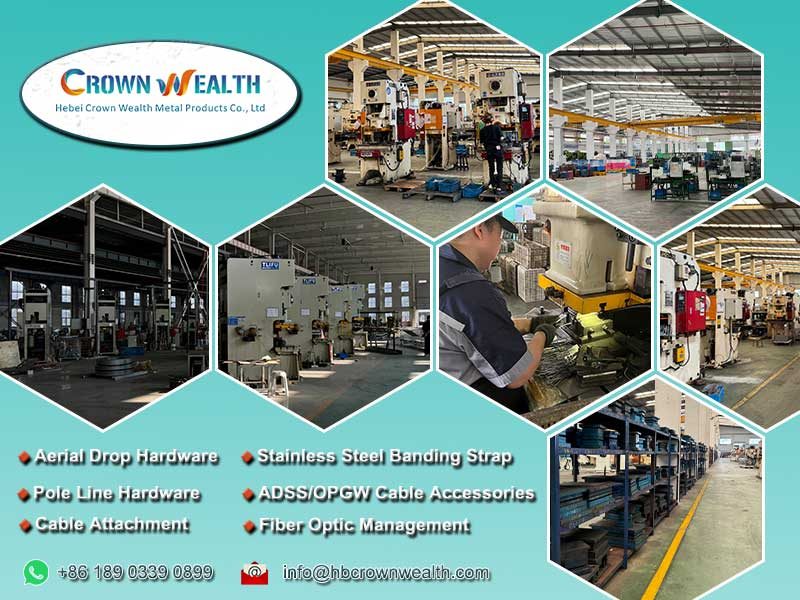
When you source suspension hardware, you need clear specifications and a supplier who understands how your order will be used. Hbcrownwealth is a professional manufacturer and wholesale supplier of power and telecommunications overhead line hardware in China, serving distributors, importers, and contractors.
You can share your cable specifications and installation drawings before ordering. This helps you clarify the required clamp configuration, supply scope, and purchasing requirements.
If your project needs a different configuration, marking, or packaging, you can discuss it through our OEM / ODM service. Send your drawing or idea so that the proposed solution can be reviewed and agreed before production.
You can discuss related suspension hardware and other overhead line accessories alongside your J hook suspension clamp order. This helps you organize the components required for your installation or distribution inventory.
Share the dimensions, material requirements, inspection criteria, and documentation your purchase requires. By agreeing on these details in advance, you give your procurement and receiving teams a clearer basis for checking the order.
Ready to source the CW-CSC for your project? Contact Hbcrownwealth with your cable diameter, span requirements, and order quantity to request a quotation.
| Parameter | Specification |
|---|---|
| Product model | CW-CSC |
| Product name | J Hook Suspension Clamp |
| Alternative name | J Type Fiber Optic Cable Suspension Clamp |
| Cable type | Round ADSS fiber optic cable |
| Cable outside diameter | 8–12 mm |
| Body material and finish | Hot-dip galvanized steel |
| Cable-contact insert | Rubber |
| Listed span range | 50–200 m |
| Minimum breaking load (MBL) | 6 kN |
| Intended support position | Intermediate poles in aerial cable routes |
The span range is a product selection reference. Your actual span must account for cable weight, sag, wind and ice loading where applicable, pole arrangement, and the requirements of your cable manufacturer.
Hbcrownwealth is proudly powered by WordPress


