English
 Spanish
 French
 Arabic
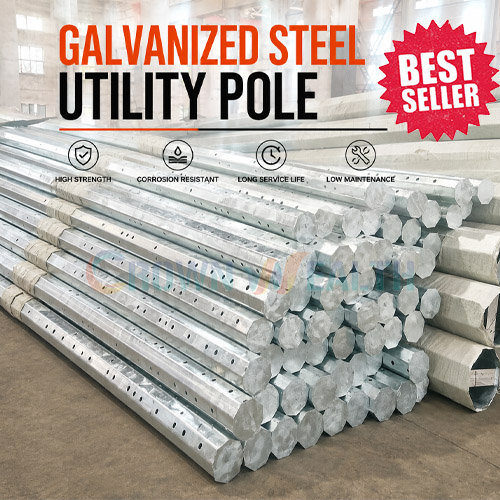
Steel utility poles support overhead power lines, telephone cables, fiber optic networks, and associated equipment. When you select a pole, its height is only one part of the specification. You also need to consider structural loads, corrosion protection, mounting hardware, and foundation requirements.
Whether you are sourcing a steel telephone pole for a communication route or comparing galvanized poles for a power distribution project, the following seven questions will help you prepare a clearer specification and evaluate supplier quotations.

1. What Are Steel Utility Poles Used For?
Steel utility poles are structural supports for overhead cables and equipment in power and communication networks. Their suitability depends on the pole design and the loads it is intended to carry.
Different product names often describe the material or application rather than a separate type of structure.
| Term | What it describes | What you should verify |
|---|---|---|
| Steel utility pole | A steel pole designed for utility infrastructure | Intended application, dimensions, and design loads |
| Steel telephone pole | A steel pole used to support telephone or other communication cables | Cable arrangement, attachment positions, and route loads |
| Metal telephone pole | A broader material description for a communication pole | The actual metal, protective finish, and structural specification |
| Steel power pole | A steel pole intended for an electrical line application | Conductor loads, equipment loads, clearances, and grounding provisions |
| Galvanized steel utility pole | A steel pole with a zinc coating for corrosion protection | Coating requirements and suitability for the exposure conditions |
A steel telephone pole may support a modern fiber optic route as well as traditional telephone infrastructure, provided it is designed for the proposed installation.
However, a communication pole is not automatically suitable for power conductors or additional equipment. Adding cables, brackets, or other attachments changes the loading and should be reviewed before installation.
2. How Do Steel Utility Poles Compare with Wood and Concrete Poles?

Compare poles designed for the same duty, rather than assuming that one material is always stronger, lighter, or cheaper. Height alone does not establish an equivalent comparison.
Steel avoids wood-specific problems such as rot and termite consumption. It also allows manufacturers to fabricate defined dimensions and attachment arrangements. In return, steel requires an appropriate corrosion-protection system and inspection plan.
Use the following comparison to identify the practical differences relevant to your project.
| Consideration | Steel poles | Wood poles | Concrete poles |
|---|---|---|---|
| Deterioration concerns | Corrosion and coating condition | Decay, insects, and preservative condition | Cracking, spalling, and reinforcement corrosion where applicable |
| Handling | Confirm fabricated weight, lifting points, and section arrangement | Confirm weight and approved handling method | Confirm weight and lifting requirements; avoid impact damage |
| Hardware attachment | Coordinate holes, brackets, and mounting details with the design | Use fittings appropriate to the pole dimensions and utility requirements | Coordinate embedded fittings or approved attachment methods |
| Maintenance planning | Inspect the pole, coating, connections, and foundation interface | Inspect the pole condition and connections | Inspect the concrete, connections, and foundation interface |
| Cost comparison | Include coating, freight, erection, and maintenance | Include treatment, freight, erection, and maintenance | Include freight, lifting, foundation, and maintenance |
A hollow steel pole may offer a handling advantage over a concrete alternative, but the actual difference depends on the two designs. Ask for the unit weight and shipping dimensions instead of relying on a general percentage.
For procurement, compare the total installed cost and expected maintenance requirements alongside the purchase price.
3. Why Are Steel Utility Poles Galvanized, and How Long Do They Last?
Hot-dip galvanizing protects steel with a zinc coating, but it does not give every pole the same service life.
The coating provides a barrier between the steel and its environment. Zinc also provides sacrificial protection to the underlying steel. The American Galvanizers Association explains these mechanisms in its guidance on corrosion protection for steel.
Service life depends on more than the word “galvanized.” Relevant factors include:
- Coating thickness and condition.
- Coastal salt exposure or industrial pollutants.
- Moisture and drainage conditions.
- Soil characteristics around buried sections.
- Damage during transport, installation, or service.
- Inspection and maintenance practices.
Atmospheric exposure and below-ground exposure can affect the same pole differently. The American Galvanizers Association discusses these differences in its guidance on galvanized steel performance in different environments.
When comparing quotations, distinguish the specified design life from a coating-life estimate and any supplier warranty. These are different commitments.
Ask your supplier to identify the proposed coating specification and any additional protection required for the project environment. Avoid treating a general lifespan claim as a guarantee for your installation.
4. What Sizes and Shapes of Steel Utility Poles Can You Choose?
Select the pole geometry from the structural requirements, cable arrangement, and site conditions. A taller pole or thicker wall is not, by itself, proof that the pole meets your project requirements.
Steel pole designs include round and polygonal sections. An octagonal steel pole has eight sides; other configurations may be specified for particular projects.
Hbcrownwealth’s published steel utility pole range includes the following information:
| Item | Published product information |
|---|---|
| Product reference | CW-8MP-X |
| Listed height range | 6–12 m |
| Listed wall thickness range | 2–5 mm |
| Shapes described | Octagonal, hexagonal, and round |
| Protective treatment | Hot-dip galvanizing |
| Customization described | Height, thickness, and diameter, subject to project review |
These are product-range details, not a load-rating table. Confirm the exact dimensions, steel grade, structural capacity, and connection details for the pole you intend to order.
Also distinguish overall pole length from height above ground. A direct-embedded pole includes a buried section, while a base-plate-mounted pole uses a different foundation connection.
For a steel telephone pole, provide the cable and attachment arrangement. For a power pole, include conductor and equipment requirements. The application name alone does not define the necessary structure.
5. How Much Does a Steel Utility Pole Cost?
Steel utility pole prices depend on the approved specification, order quantity, and delivery requirements. There is no reliable universal price for a pole described only by its height.
Two poles of equal length can have different costs because of differences in:
- Steel grade and total steel weight.
- Wall thickness, taper, and section dimensions.
- Base plates, joints, holes, and welded attachments.
- Galvanizing and any additional coating requirements.
- Inspection and documentation requirements.
- Packaging, freight, and delivery destination.
To obtain a useful quotation, send a drawing or provide the following information.
| Information to provide | Why it matters |
|---|---|
| Intended use | Distinguishes telephone, fiber optic, power, or other applications |
| Overall length and required height above ground | Defines the basic dimensional requirement |
| Top and bottom dimensions | Identifies the proposed pole profile |
| Wall thickness and steel grade, if specified | Defines important material requirements |
| Design loads or project specification | Allows the proposed pole to be checked against the intended duty |
| Foundation arrangement | Identifies direct embedment or base-plate requirements |
| Hardware layout | Defines attachment holes, brackets, and interfaces |
| Coating requirements | Clarifies corrosion-protection expectations |
| Quantity and destination | Supports production, packing, and freight pricing |
For a fair comparison, ask each supplier to quote the same specification and state what is included. Check whether hardware, foundation components, testing, and freight are separate items.
6. How Should Steel Utility Poles Be Handled and Transported?
Use the manufacturer’s handling instructions and a lifting plan suited to the pole’s actual weight and geometry. Protecting the pole during delivery helps prevent coating repairs and installation delays.
Before dispatch, confirm the shipping length, weight, support arrangement, and unloading requirements.
During handling and storage:
- Use rated lifting equipment and the specified lifting points.
- Use suitable protective slings or padding where required.
- Support and secure poles to prevent rolling, shifting, or deformation.
- Avoid dragging poles across abrasive surfaces.
- Follow storage guidance to limit trapped moisture between closely packed galvanized surfaces.
- Inspect poles on arrival for dents, distortion, coating damage, and missing components.
Record any delivery damage before installation and obtain the appropriate repair or replacement instructions. Do not assume that every visible defect can be corrected on site.
7. How Are Steel Utility Poles Installed?
Steel utility poles must be installed to an approved structural and foundation design. Foundation depth, anchor details, and erection procedures depend on the pole loads and site conditions.
Two installation arrangements are direct embedment and base-plate mounting.
| Arrangement | Basic principle | Details requiring project-specific design |
|---|---|---|
| Direct embedment | A specified portion of the pole is installed below ground | Embedment depth, hole dimensions, soil conditions, backfill, and buried-section protection |
| Base-plate mounting | A pole base plate connects to an engineered foundation through anchor bolts | Foundation dimensions, reinforcement, anchor layout, and connection requirements |
A typical installation plan covers the following stages:
- Confirm the approved documents. Check the pole identification, foundation drawings, hardware layout, and erection requirements.
- Prepare and inspect the foundation. Verify the required dimensions and readiness before lifting.
- Lift and position the pole. Use qualified personnel and the approved lifting arrangement.
- Complete the structural connection. Follow the specified embedment or base-plate procedure.
- Install the required hardware and electrical provisions. Follow the project’s attachment, bonding, and grounding requirements.
- Inspect and record the completed installation. Check alignment, connections, coating condition, and required acceptance records.
Request Steel Utility Poles for Your Project
Hbcrownwealth is a manufacturer, supplier, and wholesaler of steel utility poles and hardware for overhead power and communication systems.
Whether you need a steel telephone pole for a communication route or galvanized steel poles for a utility project, start with a clear specification.
Send your drawings, required dimensions, application, design requirements, quantity, and delivery destination. Include the hardware layout and foundation arrangement where available.
Contact Hbcrownwealth to discuss your steel utility pole requirements and request a quotation.