English
 Spanish
 French
 Arabic
When you source poles for power distribution, overhead lines, street lighting, telecommunications, or infrastructure projects, choosing the right metal electrical pole affects installation, structural performance, maintenance, and long-term project costs.
Today, galvanized steel poles have become a practical option for many utility and infrastructure projects. They provide high structural strength, consistent dimensions, customizable designs, and corrosion protection for outdoor environments.
However, not every steel pole has the same shape or construction. You can choose round steel poles, octagonal steel poles, or polygonal steel poles according to your project requirements.
So, which type should you choose?
In this guide, you will learn the differences between the main galvanized steel utility pole designs, their typical applications, the specifications you should confirm before ordering, and how Hbcrownwealth manufactures customized steel poles for international projects.
What Is a Metal Electrical Pole?
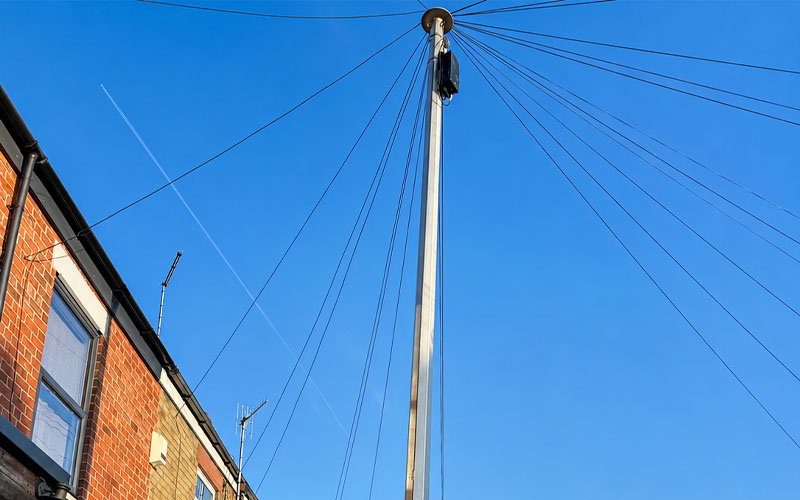
A metal electrical pole is a steel structure that supports electrical conductors, transformers, crossarms, insulators, communication cables, lighting equipment, or other overhead line components.
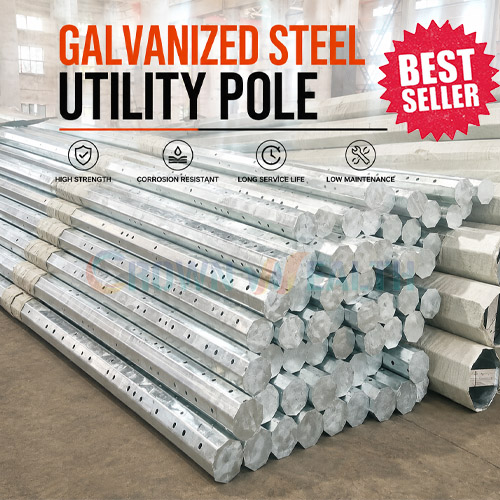
Manufacturers normally produce these poles from structural steel plate or steel tube. Depending on the design, the pole can have a round, octagonal, or multi-sided cross-section.
For outdoor applications, manufacturers often apply hot-dip galvanizing to the steel surface. The zinc coating helps protect the steel against corrosion caused by rain, humidity, and outdoor exposure.
As a result, galvanized steel utility poles work well in power distribution, telecommunications, street lighting, rural electrification, and other infrastructure projects.
Why Choose a Galvanized Steel Utility Pole?
When you compare different pole materials, galvanized steel offers several practical advantages.
High Structural Strength
Steel provides strong mechanical performance while allowing manufacturers to control wall thickness, diameter, taper, and overall pole geometry.
Therefore, you can design the pole according to different wind loads, equipment loads, line configurations, and installation conditions.
Reliable Corrosion Protection
Hot-dip galvanizing creates a protective zinc coating over the steel surface.
This coating helps reduce direct exposure between the steel and the surrounding environment. Consequently, the pole requires less surface maintenance than untreated steel.
Consistent Dimensions
Steel fabrication allows manufacturers to maintain more consistent dimensions during mass production.
This consistency becomes especially important when you purchase poles for large utility, telecom, or infrastructure projects.
Flexible Customization
You can customize a galvanized steel pole according to your project drawing.
Common options include:
- Pole height
- Wall thickness
- Top diameter
- Bottom diameter
- Pole shape
- Base plate dimensions
- Hole position
- Crossarm mounting holes
- Cable openings
- Flange design
- Buried or base-mounted installation
- Galvanizing requirements
Therefore, steel poles work well for both standard distribution projects and customized engineering applications.
Round vs Octagonal vs Polygonal Metal Electrical Poles
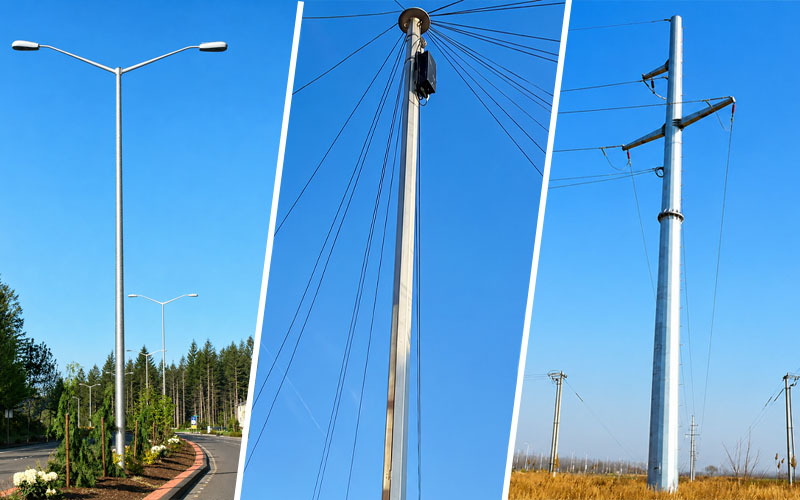
The pole shape affects appearance, manufacturing, structural design, installation, and project requirements.
Here is a simple comparison.
| Pole Type | Main Characteristics | Typical Applications |
|---|---|---|
| Round Steel Pole | Smooth circular appearance and uniform profile | Power distribution, telecom, street lighting |
| Octagonal Steel Pole | Eight-sided profile with strong structural rigidity | Utility lines, overhead distribution, lighting |
| Polygonal Steel Pole | Multi-sided engineered structure | Customized utility, transmission and infrastructure projects |
You should not select a pole only by appearance. Instead, confirm the load requirement, pole height, wind condition, installation method, and engineering drawing.
Round Galvanized Steel Poles
A round steel pole has a circular cross-section and a smooth external appearance.
You can use round poles for electrical distribution, telecommunications, street lighting, surveillance equipment, and other infrastructure systems.
Advantages of Round Steel Poles
Round poles provide a clean and simple appearance. In addition, their symmetrical shape makes them suitable for applications where loads may act from different directions.
They also work well in urban environments where appearance matters.
Common Applications
You can use round galvanized steel poles for:
- Power distribution
- Street lighting
- Telecommunication cables
- CCTV systems
- Public infrastructure
- Industrial facilities
- Residential developments
If your project needs a simple and versatile steel pole, the round design can be a suitable option.
Galvanized Octagonal Steel Poles
An octagonal steel pole has eight flat sides.
This design is widely used in utility and infrastructure applications because it combines structural strength with efficient steel plate forming.
For many power distribution projects, the octagonal shape provides a practical balance between strength, weight, fabrication, and transportation.
Advantages of Octagonal Steel Poles
The multi-flat-sided profile improves structural rigidity while allowing manufacturers to form tapered poles from steel plate.
In addition, octagonal poles can support customized crossarms, insulators, lighting fixtures, cable equipment, and other pole line hardware.
Common Applications
You can use galvanized octagonal steel poles for:
- Overhead power distribution
- Electrical utility networks
- Rural electrification
- Street lighting
- Industrial power systems
- Telecommunication infrastructure
If you need a strong and widely adaptable utility pole, an octagonal steel pole is often worth considering.
Galvanized Polygonal Steel Poles
A polygonal steel pole uses multiple flat sides to create an engineered pole profile.
Depending on the design, the pole may have more sides than a standard octagonal structure.
Manufacturers can adjust the number of sides, taper, wall thickness, and section dimensions according to engineering requirements.
Advantages of Polygonal Steel Poles
Polygonal designs give engineers greater flexibility when they need to control strength, stiffness, weight, or pole geometry.
They also suit larger or more specialized infrastructure projects where standard round or octagonal poles may not meet the required design.
Common Applications
Polygonal steel poles can serve:
- Utility distribution networks
- High-load infrastructure
- Transmission-related projects
- Road lighting
- Industrial projects
- Customized engineering systems
For these projects, you should provide drawings and structural requirements before production.
How Do You Choose the Right Metal Electrical Pole?
Before you request a quotation, prepare the main technical requirements.
This information helps the manufacturer calculate the correct pole structure and avoid unnecessary revisions.
1. Confirm the Pole Height
First, determine the total pole height.
Common utility poles can vary significantly in height according to the network design, conductor clearance, installation method, and local requirements.
Therefore, you should provide the exact height instead of simply requesting a “standard utility pole.”
2. Confirm the Wall Thickness
Steel thickness affects pole strength, weight, cost, and structural performance.
However, thicker steel does not automatically mean a better pole.
You should choose the thickness according to the structural design, wind load, top load, equipment load, and required safety factor.
3. Provide the Top and Bottom Diameter
Tapered steel poles usually have different top and bottom dimensions.
These dimensions affect structural capacity and compatibility with other equipment.
Therefore, include both dimensions in your drawing or specification.
4. Confirm the Wind Load
Wind load can have a major effect on pole design.
If you are buying steel utility poles for coastal, desert, open plain, or high-wind regions, provide the required wind speed or engineering load data.
The manufacturer can then evaluate the pole dimensions accordingly.
5. Define the Installation Method
You can install a steel utility pole in different ways.
Common options include:
- Direct burial
- Base plate mounting
- Flange mounting
If you need a base plate, also provide:
- Plate dimensions
- Plate thickness
- Bolt-hole pattern
- Anchor bolt dimensions
6. Confirm Equipment and Top Load
Tell the manufacturer what the pole needs to support.
For example, your pole may carry:
- Crossarms
- Insulators
- Electrical conductors
- Transformers
- Telecom cables
- Streetlights
- Cameras
- Antennas
This information helps determine the correct structural design.
7. Confirm Galvanizing Requirements
For outdoor steel utility poles, specify the required galvanizing standard or coating requirements.
If your project has a particular zinc coating thickness or corrosion resistance requirement, include it in your purchase specification.
8. Provide Hole and Access Requirements
Many electrical poles need customized holes for crossarms, bolts, cables, grounding, or maintenance access.
Therefore, provide a detailed drawing showing:
- Hole diameter
- Hole position
- Hole spacing
- Cable openings
- Hand holes
- Equipment mounting points
This step helps avoid modification during installation.
Typical Applications of Metal Electrical Poles
Because manufacturers can customize steel poles, you can use them across several infrastructure sectors.
Power Distribution Networks
Utility companies and electrical contractors use galvanized steel poles to support overhead distribution lines, conductors, crossarms, and insulators.
Rural Electrification
Steel utility poles can support power infrastructure in rural and developing areas where projects require durable and consistent pole structures.
Telecommunication Networks
You can also use metal poles for telecom cables, fiber optic networks, antennas, and communication equipment.
Street Lighting
Round, octagonal, and polygonal steel poles can support lighting fixtures along roads, industrial parks, residential communities, and public spaces.
Industrial Infrastructure
Factories, ports, warehouses, mines, and industrial projects may also use galvanized steel poles for power, lighting, communications, and monitoring systems.
How Hbcrownwealth Manufactures Galvanized Steel Utility Poles
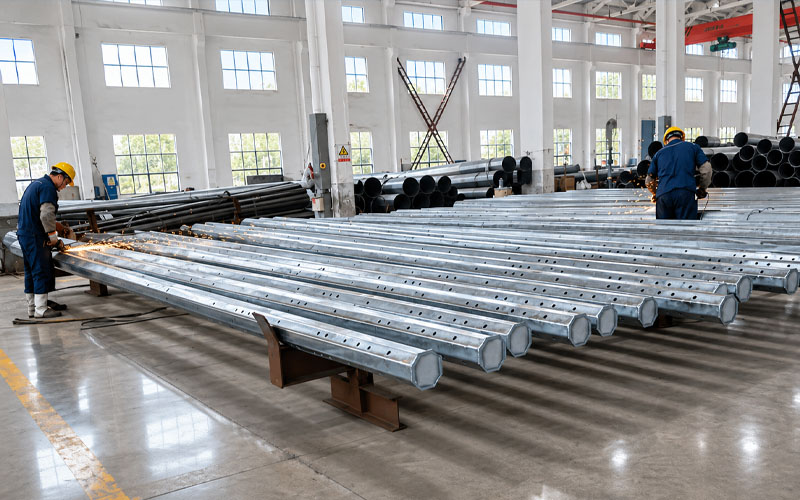
At Hbcrownwealth, we manufacture galvanized steel utility poles for distributors, utility contractors, engineering companies, importers, and infrastructure project buyers.
We produce round, octagonal, and polygonal steel poles according to customer drawings and project requirements.
A typical production process includes several stages.
Steel Material Preparation
First, our production team checks the steel material according to the confirmed specification.
We then prepare the steel plate or tube for cutting and forming.
Cutting
Next, we cut the steel according to the required dimensions.
For tapered poles, accurate cutting helps control the final top diameter, bottom diameter, and overall geometry.
Forming and Bending
Our equipment forms the steel into the required round, octagonal, or polygonal shape.
At this stage, we control the profile and dimensions before welding.
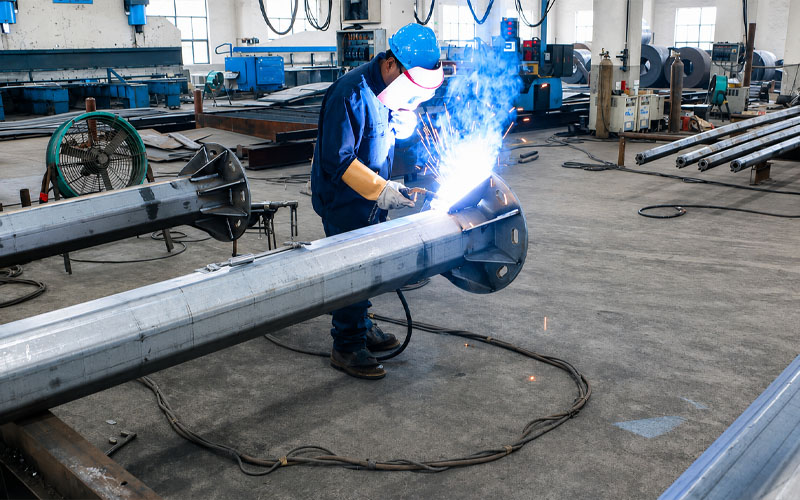
Welding
After forming, we weld the steel sections according to the production requirements.
We then inspect the weld area before moving to the next process.
Hole Processing
We create the required mounting holes, cable openings, access holes, and other customized details according to the approved drawing.
Straightening and Dimensional Inspection
Next, we check the pole straightness and important dimensions.
This step helps ensure that each pole matches the confirmed specification.
Hot-Dip Galvanizing
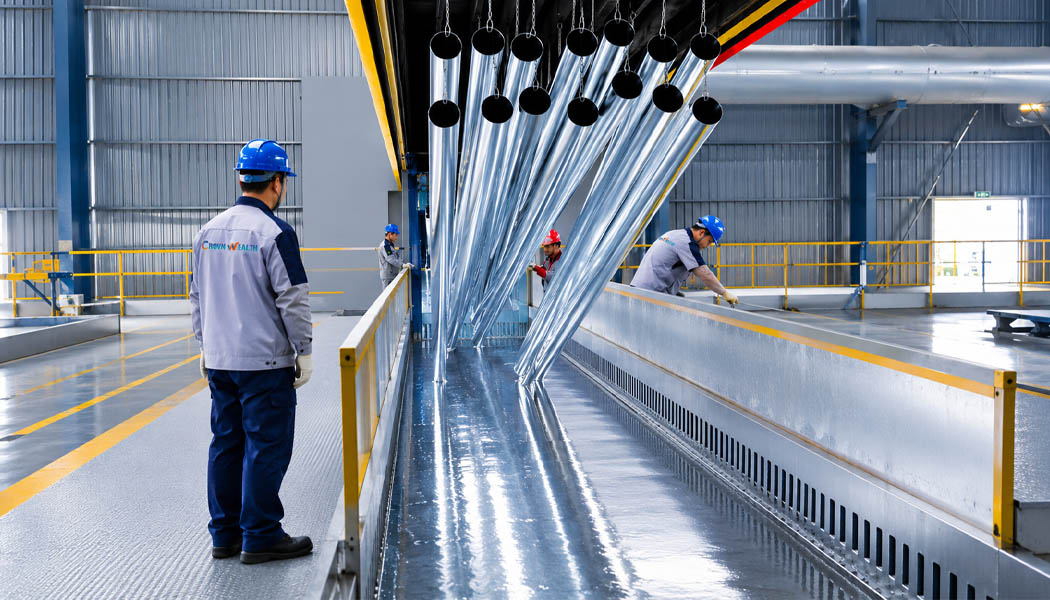
After fabrication, we apply the required corrosion protection process.
For galvanized steel utility poles, hot-dip galvanizing helps protect the steel surface for outdoor service.
Final Inspection and Packaging
Finally, we inspect the dimensions, surface, hole position, galvanizing appearance, and packaging before shipment.
Quality Control for Galvanized Steel Poles
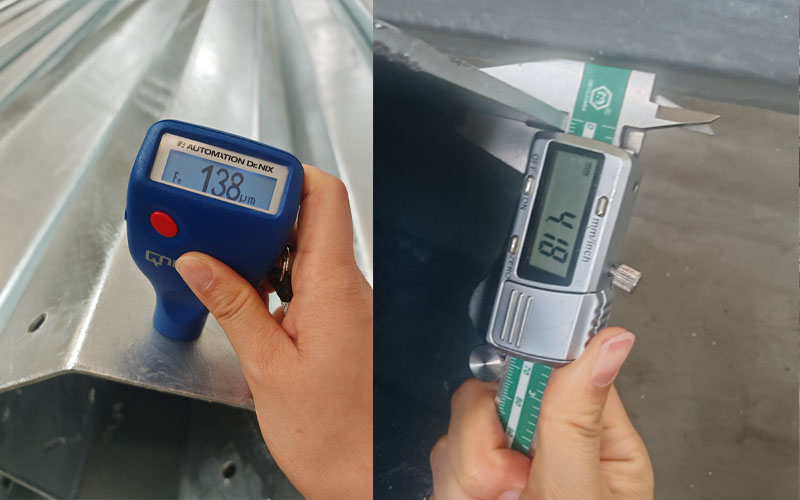
When you purchase utility poles in large quantities, consistent quality becomes especially important.
Therefore, Hbcrownwealth checks key product characteristics throughout production.
Our quality control process can include:
- Raw material inspection
- Pole height measurement
- Wall thickness inspection
- Top and bottom diameter inspection
- Straightness inspection
- Welding inspection
- Hole size and position inspection
- Base plate inspection
- Galvanized surface inspection
- Coating thickness inspection
- Final appearance inspection
- Packaging inspection
If your project requires additional testing or third-party inspection, you can send us the inspection requirements before production.
OEM and Custom Metal Electrical Pole Manufacturing
Different countries, utilities, contractors, and engineering companies use different pole specifications.
Therefore, we support customized manufacturing instead of limiting you to only one standard design.
You can send us your:
- Engineering drawing
- Pole height
- Steel grade
- Wall thickness
- Top diameter
- Bottom diameter
- Pole shape
- Wind load
- Working load
- Hole layout
- Base plate design
- Galvanizing requirement
- Order quantity
Our team can then review the information and discuss a suitable manufacturing solution with you.
We also support OEM production and customized packaging for distributors and importers.
Why Choose Hbcrownwealth as Your Steel Utility Pole Supplier?
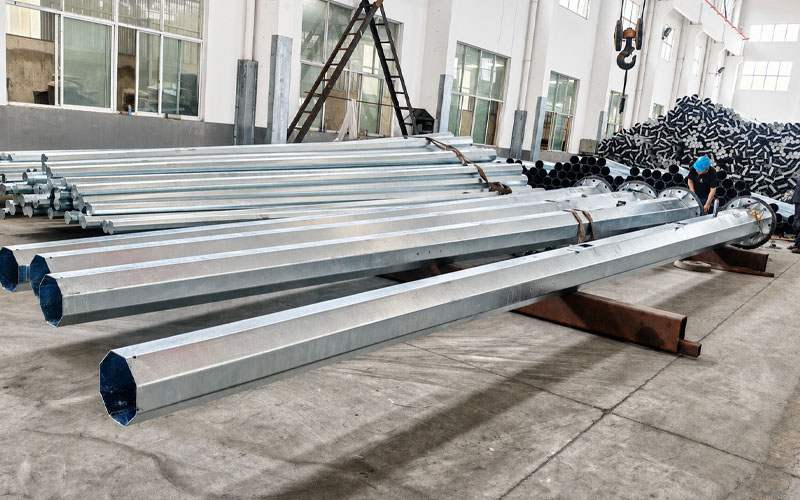
Hbcrownwealth is a professional manufacturer and wholesale supplier of galvanized steel utility poles and pole line hardware in China.
We supply round steel poles, octagonal steel poles, polygonal steel poles, and related utility hardware to international customers.
When you work with us, you can combine customized pole manufacturing with other pole line hardware sourcing.
For example, you can source steel poles together with:
- Crossarms
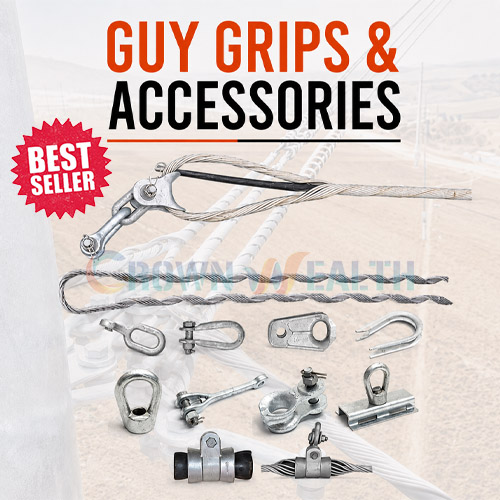
- Guy hardware
- Eye bolts
- U bolts
- Pole bands
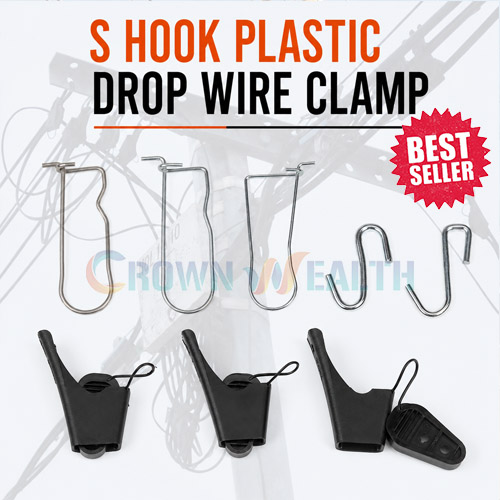
- Cable clamps
- Suspension hardware
- Anchor hardware
- Other pole line accessories
As a result, you can simplify purchasing and reduce the number of suppliers involved in your project.
In addition, we focus on stable production, dimensional consistency, quality control, export packaging, and repeat-order reliability.
Frequently Asked Questions About Metal Electrical Poles
What is the best material for an electrical utility pole?
The correct material depends on the project environment, structural requirements, installation method, maintenance plan, and budget.
Galvanized steel is a common choice when you need high structural strength, dimensional consistency, customization, and corrosion protection.
What is the difference between round and octagonal steel poles?
A round pole has a circular cross-section, while an octagonal pole has eight flat sides.
Both designs can support utility and infrastructure applications. However, the correct choice depends on your engineering requirements, appearance, load, fabrication design, and project specification.
Are steel utility poles galvanized?
Many outdoor steel utility poles use hot-dip galvanizing to improve corrosion resistance.
You should confirm the required galvanizing specification before placing an order.
Can you customize the pole height and thickness?
Yes. Hbcrownwealth can manufacture steel utility poles according to customer drawings and project specifications.
You can customize height, thickness, diameter, shape, holes, base plate, and other structural details.
Can you manufacture octagonal electrical poles?
Yes. We manufacture galvanized octagonal steel poles for power distribution, street lighting, utility, telecom, and infrastructure projects.
Can you manufacture polygonal steel poles?
Yes. We can manufacture polygonal steel poles according to approved drawings and technical requirements.
What information do I need for a quotation?
For a more accurate quotation, send us:
- Pole shape
- Height
- Steel thickness
- Top diameter
- Bottom diameter
- Steel grade
- Installation method
- Wind load
- Equipment load
- Galvanizing requirement
- Drawing
- Quantity
- Destination
The more complete your specification is, the faster we can prepare a suitable quotation.
Request a Quote for Galvanized Steel Utility Poles
Choosing the right metal electrical pole starts with understanding your project requirements.
Round, octagonal, and polygonal steel poles each offer different advantages. Therefore, you should select the final design according to pole height, load, wind conditions, installation method, equipment configuration, and engineering requirements.
If you are looking for a reliable galvanized steel utility pole manufacturer in China, Hbcrownwealth can support standard and customized projects.
Send us your pole drawing, dimensions, galvanizing requirements, project quantity, and destination.
Our team will review your specifications and provide a suitable manufacturing and quotation solution.