English
 Spanish
 French
 Arabic
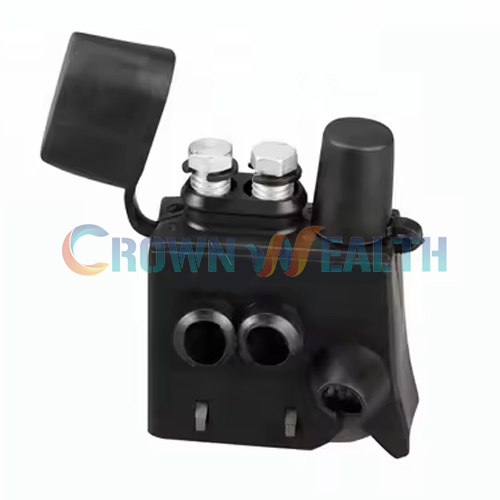
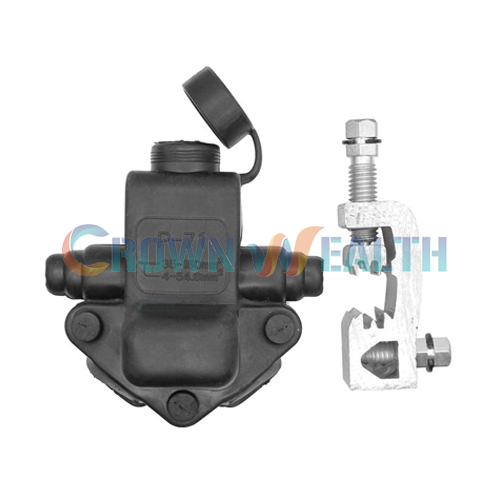
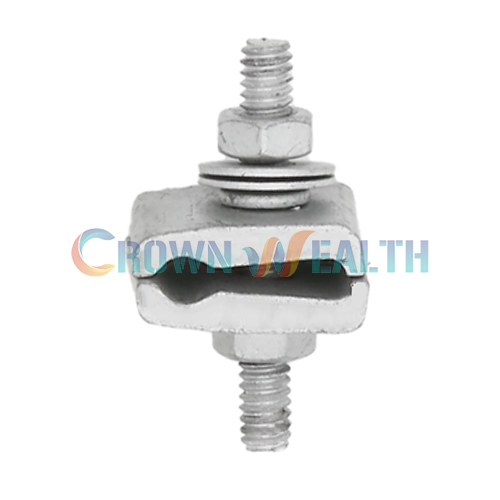
Overhead line hardware includes the mechanical fittings you use to support, anchor, terminate, protect, and attach aerial power, telecom, and fiber optic cables.
Although these components may look simple, they directly affect cable tension, bend control, pole stability, installation efficiency, and long-term network reliability. If you choose the wrong clamp or fitting, you may face cable slippage, excessive stress, abrasion, corrosion, or premature maintenance.
In this guide, you will learn how the main types of overhead line hardware work, where you should use them, and what technical information you should check before ordering aerial cable fittings for your project.
What Is Overhead Line Hardware?
Overhead line hardware is a broad group of fittings used to connect cables, conductors, guy strands, poles, towers, brackets, and other support structures.
Depending on your network, you may also see these products described as pole line hardware, aerial cable fittings, aerial drop hardware, power line accessories, telecom line hardware, or ADSS cable accessories.
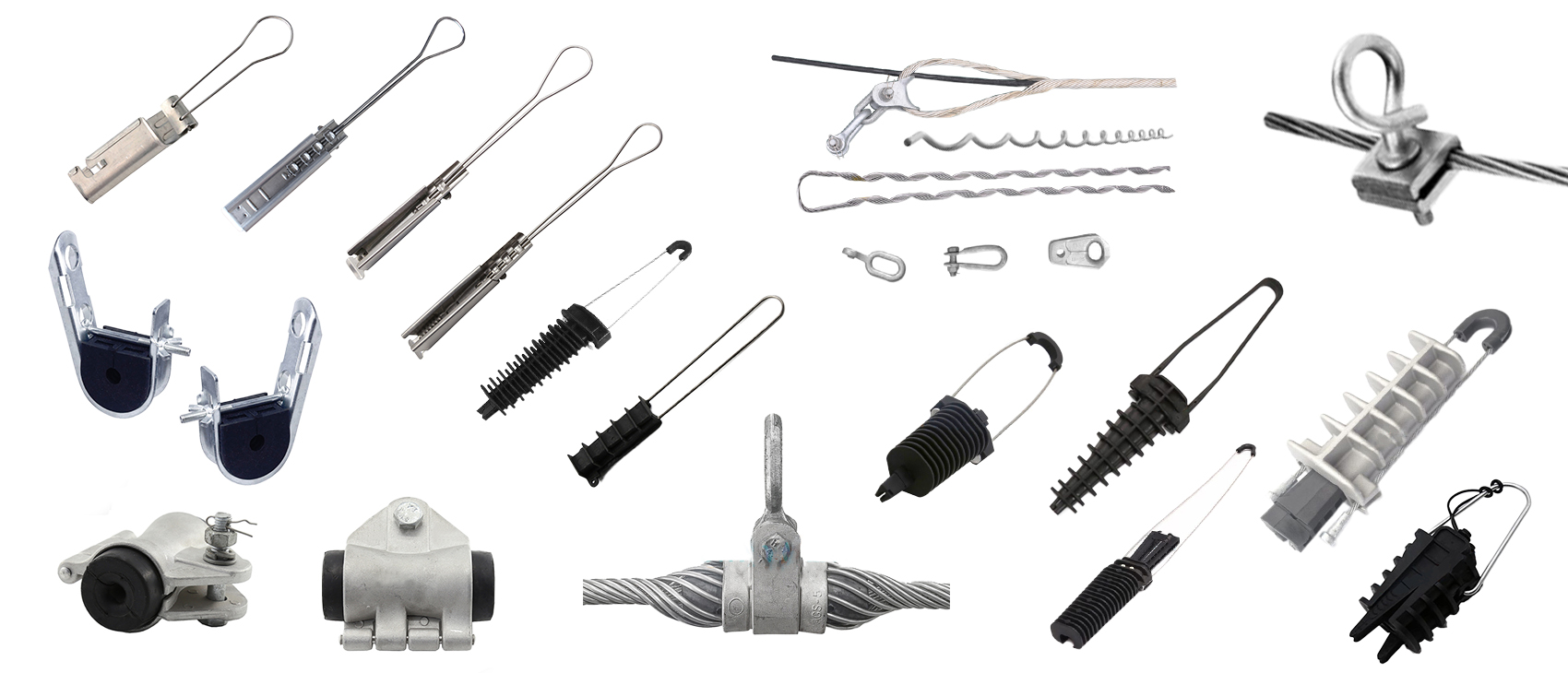
Different fittings perform different mechanical functions.
| Hardware Type | Main Function | Typical Application | Key Selection Factors |
|---|---|---|---|
| Anchoring Clamp | Terminates and tensions cable | ADSS, ABC, Figure-8 cable | Cable type, diameter, tensile load |
| Suspension Clamp | Supports cable at intermediate points | ADSS, ABC, fiber optic cable | Diameter, load, line angle, bend control |
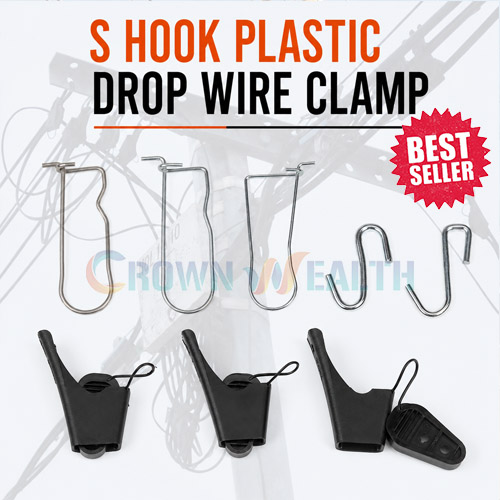
| Drop Wire Clamp | Secures service or subscriber drops | FTTH, CATV, telecom | Drop cable type, messenger, span |
| Guy Grip Dead End | Terminates and grips guy strand | Utility poles, telecom poles | Strand diameter, construction, lay |
| Lashing Clamp | Secures lashing wire | Aerial telecom networks | Cable bundle and lashing wire size |
| Pole Band / Fixing Band | Creates mounting points | Wood, concrete, or steel poles | Pole diameter, load, material |
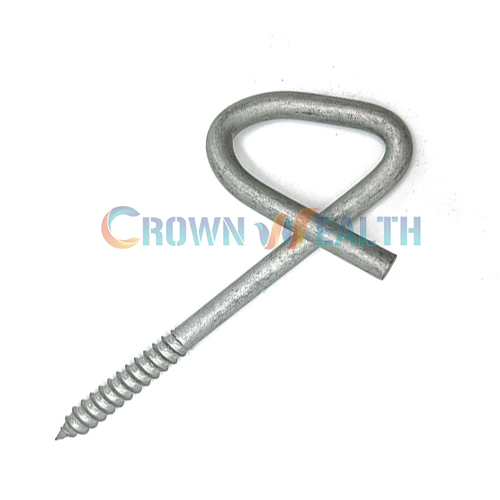
| Hooks and Bolts | Connect clamps to structures | Utility and telecom installations | Thread size, mounting geometry, coating |
Therefore, you should select each component according to its actual mechanical purpose rather than choosing only by appearance.
1. Anchoring Clamps: Controlling Cable Tension

An anchoring clamp, also called an anchor clamp or tension clamp, secures a cable at a termination point or tension section.
You commonly use anchoring clamps with ADSS fiber optic cables, aerial bundled cables (ABC), Figure-8 cables, and other self-supporting aerial cables.
The clamp transfers longitudinal cable tension to a pole, bracket, hook, or other support structure.
How Does an Anchoring Clamp Work?
Many anchoring clamps use a wedge system. As cable tension increases, the wedge increases its grip on the cable.
Other applications use preformed helical tension fittings.
A properly selected clamp should hold the cable securely while controlling local pressure on the cable jacket or messenger.
For fiber optic applications, this is especially important because excessive compression or bending can affect the cable structure and optical performance.
You should always match the clamp to the exact cable construction. For example, an ABC tension clamp and an ADSS anchoring clamp may look similar, but they are not automatically interchangeable.
What Should You Check Before Ordering?
Start with the cable type and outside diameter. Then confirm the required mechanical load, span length, messenger construction, attachment method, and environmental conditions.
For outdoor installations, UV-resistant engineering polymers, aluminum alloys, stainless steel components, and corrosion-resistant steel parts can help improve long-term performance.
If your project is located near the coast, in a highly humid area, or in an industrial environment, you should pay additional attention to corrosion resistance.
2. Drop Wire Clamps: Securing FTTH and Telecom Connections
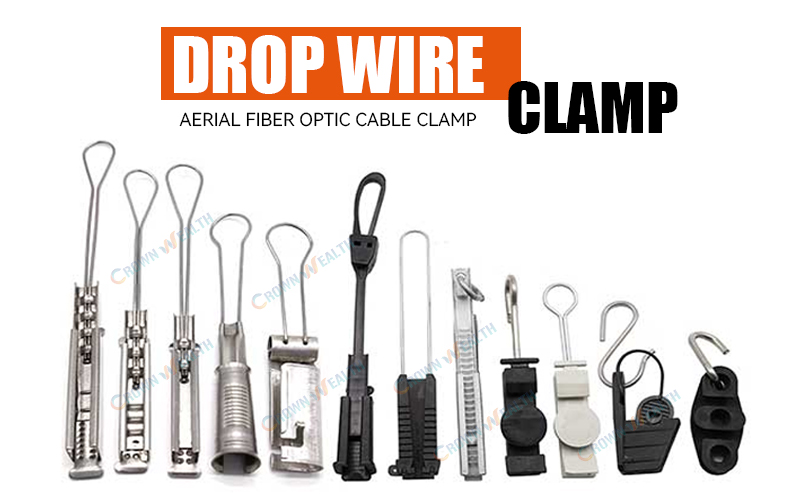
A drop wire clamp secures the final aerial connection between the distribution network and a subscriber, building, or terminal point.
You commonly see these fittings in FTTH, CATV, telephone, and other telecom networks.
Depending on the cable, the clamp may grip a messenger wire, reinforced section, Figure-8 cable, flat drop cable, or round fiber optic cable.
Why Drop Cable Design Matters
There is no single drop wire clamp suitable for every drop cable.
Before choosing one, identify the cable construction first.
For example, a stainless steel telecom drop wire clamp, plastic FTTH wedge clamp, S-hook drop clamp, and Figure-8 cable clamp all use different gripping methods.
The correct fitting should provide sufficient holding force without crushing, cutting, or excessively bending the cable.
Installation speed also matters when you manage large FTTH projects. Tool-free or simplified clamp designs can reduce field installation time, especially when technicians need to complete many subscriber connections each day.
3. Suspension Clamps: Supporting Intermediate Spans
While an anchoring clamp handles longitudinal tension, a suspension clamp supports the cable at intermediate poles.
This difference is important.
A suspension clamp carries vertical and transverse loads while allowing the cable to follow the designed route through the network. Depending on the fitting design, it can also help control cable movement caused by wind and vibration.
You commonly use suspension clamps for ADSS cables, ABC conductors, Figure-8 cables, and other aerial lines.
Why Cable Diameter and Bend Radius Matter
For fiber optic cables, you should avoid excessive bending or concentrated pressure.
Therefore, check the compatible cable diameter and the contact area between the clamp and cable before installation.
You should also consider the allowable line angle. A tangent installation and a significant directional change may require different suspension hardware.
For ADSS projects, the cable manufacturer’s recommended tensile load and minimum bend radius should form part of your selection process.
4. Guy Grip Dead Ends: Stabilizing Utility and Telecom Poles
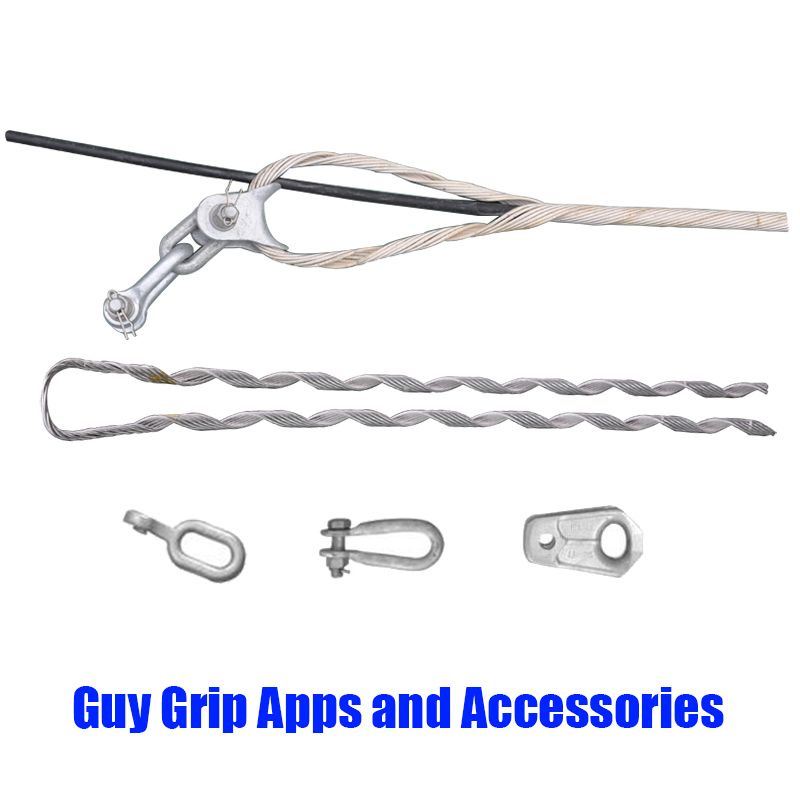
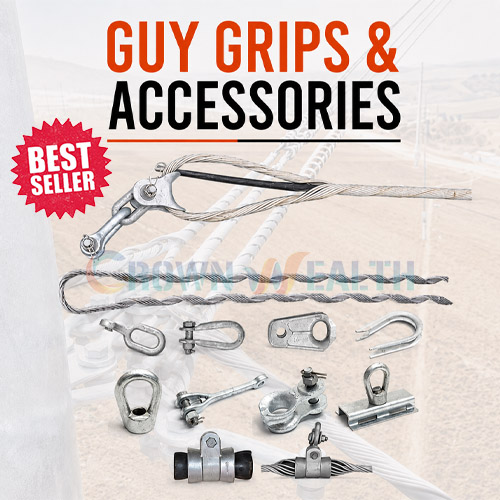
A guy grip dead end, also known as a preformed guy grip or preformed dead end, terminates guy strand used to stabilize poles.
Unlike many bolted guy clamps, a preformed guy grip wraps helically around the strand.
The helical rods create friction over a relatively long contact area. This allows the fitting to transfer load without relying on a single concentrated clamping point.
Why Must the Guy Grip Match the Strand?
Guy grips are size-specific.
Before ordering, you should confirm the guy strand diameter, strand construction, material, lay direction, and required mechanical strength.
A fitting designed for one strand size should not automatically be installed on another size simply because it appears close.
Correct matching helps the grip wrap properly around the strand and transfer tension as designed.
For galvanized steel guy strands, you should also confirm the required corrosion protection and coating specification for your target market.
5. Supporting Pole Line Hardware
Clamps and guy grips cannot work alone. A complete aerial network also requires supporting pole line hardware.
Pole bands, stainless steel banding, fixing bands, hooks, eye bolts, thimble eye nuts, crossarm hardware, lashing clamps, brackets, and other attachment fittings create the mechanical connection between your cable system and the supporting structure.
For example, you may use a pole band to create an attachment point on a concrete pole, while a drive hook or house hook may provide the attachment point for a telecom drop wire clamp.
Because these products work as a system, check the complete connection rather than evaluating only one component.
The weakest connection point can determine the performance of the entire assembly.
How Do You Choose the Right Overhead Line Hardware?
When you source aerial cable fittings, provide your supplier with as much project information as possible.
- Identify the cable or strand. Provide the cable type, outside diameter, construction, messenger material, and conductor or fiber configuration.
- Define the mechanical requirement. Confirm span length, expected working load, installation angle, termination points, and any relevant safety factors required by your project specification.
- Check environmental exposure. Consider UV exposure, coastal salt, humidity, industrial pollution, temperature range, and corrosion risk.
- Confirm the support structure. Tell your supplier whether you use wood poles, concrete poles, steel poles, towers, walls, crossarms, hooks, or brackets.
- Review materials and coatings. Depending on the application, you may require UV-resistant polymers, aluminum alloy, stainless steel, galvanized steel, or hot-dip galvanized components.
- Request technical documentation. Before a large order, review dimensional drawings, material specifications, mechanical test information, coating requirements, samples, and installation instructions when applicable.
This information allows your supplier to recommend a fitting based on engineering requirements instead of guessing from a photograph.
Materials Used in Aerial Cable Fittings
Manufacturers select materials according to mechanical strength, cable compatibility, corrosion resistance, weight, and installation requirements.
Engineering plastics are common in ADSS and FTTH clamps because they provide low weight, electrical insulation, and resistance to outdoor weathering when properly formulated.
Aluminum alloys provide good strength-to-weight performance and corrosion resistance.
Stainless steel is widely used for bails, wire loops, straps, and other outdoor components.
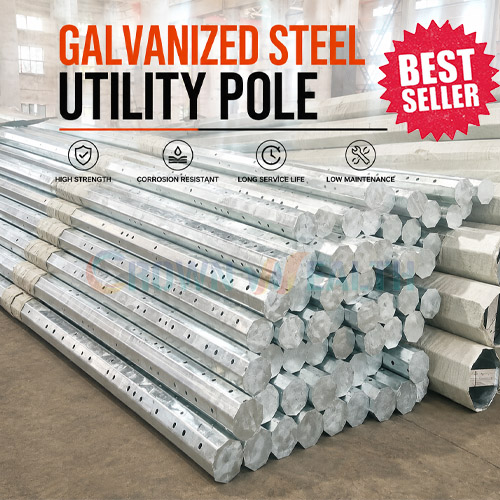
Hot-dip galvanized steel is commonly used for many structural pole line fittings where strength and corrosion protection are both required.
However, you should specify the material and coating according to the actual product and project standard rather than applying one coating specification to every component.
Quality Standards & Manufacturing Excellence
- IEC 61284: Overhead lines – Requirements and tests for fittings.
- ANSI C29 Series: Insulator and hardware standards.
- ISO 9001: Quality management systems.
Overhead Line Hardware for Power and Fiber Optic Projects
At Hbcrownwealth, we manufacture and supply overhead line hardware for power distribution, telecom, FTTH, ADSS, and other aerial cable networks.
Our product range includes anchoring clamps, suspension clamps, drop wire clamps, preformed guy grips, lashing clamps, pole bands, fixing bands, hooks, bolts, and other pole line accessories.
We also support OEM and ODM requirements for distributors, importers, utility hardware suppliers, telecom contractors, and project procurement companies.
If you provide your cable diameter, drawing, mechanical requirement, application, quantity, and destination market, our team can help you identify suitable hardware and prepare a quotation for your project.
Frequently Asked Questions About Overhead Line Hardware
What is overhead line hardware?
Overhead line hardware includes the mechanical fittings used to support, anchor, terminate, attach, and protect conductors, fiber optic cables, guy strands, and related equipment on poles and towers.
What is the difference between an anchoring clamp and a suspension clamp?
An anchoring clamp holds longitudinal cable tension at a termination or tension point. A suspension clamp supports the cable at intermediate poles and mainly manages vertical and transverse loads.
How do I choose the correct anchoring clamp?
Start with your cable type and outside diameter. Then check the required tensile load, messenger construction, span, attachment point, and environmental conditions.
What information do I need when ordering a drop wire clamp?
Provide the drop cable type, dimensions, messenger construction if present, application, span, mounting point, and required holding strength.
How do I select a preformed guy grip?
Confirm the guy strand diameter, strand construction, lay direction, material, and mechanical requirement. Preformed grips should be matched to the specific strand they are designed to fit.
Can I use the same hardware for ADSS and ABC cables?
Not automatically. ADSS fiber optic cables and ABC power conductors have different constructions and mechanical requirements. Always select a clamp specifically designed and tested for your cable type.
Which material is best for outdoor pole line hardware?
There is no single best material for every application. Galvanized steel, stainless steel, aluminum alloy, and UV-resistant polymers each provide different advantages. Your choice should depend on mechanical load, environment, cable type, and project specification.
What should I send a manufacturer before requesting a quotation?
Send your product drawing or reference photo together with the cable or strand diameter, material, mechanical requirement, quantity, application, destination country, and any required standards. This helps the manufacturer recommend the correct model and provide a more accurate quotation.