English
 Spanish
 French
 Arabic
When you install aerial fiber optic cables on utility or telecom poles, you need reliable hardware to support the cable without creating excessive pressure on its outer jacket. A J Hook Suspension Clamp provides a practical solution for supporting ADSS cables at intermediate suspension points.
For networks that carry two parallel ADSS cables, a double cable J hook suspension clamp allows you to support both cables with one compact pole-mounted assembly.
This guide explains what a J hook suspension clamp is, how it works, where you can use it, its main advantages, and what you should check before choosing one for your telecom or fiber optic network.
Table of Contents
ToggleWhat Is a J Hook Suspension Clamp?
A J Hook Suspension Clamp is pole line hardware designed to support ADSS fiber optic cables at intermediate points along an aerial cable route.
The clamp typically combines a strong galvanized steel support body with a protective rubber or neoprene cable insert.
The metal structure carries the mechanical load, while the softer cable-contact area helps cushion and support the cable jacket.
Unlike a dead-end or tension clamp, a suspension clamp normally supports the cable along the route rather than terminating it.
Therefore, you can use J hook suspension clamps on telecom poles, utility poles, and other aerial fiber infrastructure where the cable continues to the next support point.
What Is a Double Cable J Hook Suspension Clamp?
A double cable J hook suspension clamp is designed to support two ADSS cables at the same suspension point.
Instead of installing two completely separate suspension assemblies, you can use one double-cable design to organize and support parallel fiber optic cables.
This configuration can be useful when:
- Two ADSS cables follow the same pole route
- You expand an existing fiber network
- Your telecom project requires multiple cable paths
- You want to organize pole-mounted cable hardware
- You need a compact suspension solution for two cables
For the Hbcrownwealth CW-SDC design, the clamp uses galvanized steel together with protective rubber material and is designed for ADSS cable applications.
How Does a J Hook Suspension Clamp Work?
The working principle is straightforward.
First, you mount the J-shaped support assembly onto the appropriate pole hardware.
Next, you place the ADSS cable into the protective cable-support section.
The rubber or neoprene insert then supports the cable while the galvanized steel structure transfers the mechanical load to the pole or mounting point.
A typical load path looks like this:
ADSS Cable → Protective Rubber Insert → J Hook Suspension Clamp → Pole Hardware → Utility Pole
This design allows the cable to remain supported while reducing direct contact between the fiber optic cable jacket and hard metal surfaces.
As a result, you can achieve a stable suspension point without unnecessarily compressing or damaging the cable.
Why Is the Rubber Insert Important?
ADSS fiber optic cable requires careful mechanical support.
If a hard metal component applies excessive concentrated pressure directly to the cable jacket, it may create unwanted stress at the contact point.
For this reason, many suspension clamps use rubber, neoprene, or another resilient material around the cable.
The protective insert can help you:
- Distribute pressure over a wider area
- Reduce direct metal-to-cable contact
- Cushion the cable
- Limit abrasion
- Support the cable during normal movement
- Protect the outer jacket from localized mechanical stress
For outdoor applications, UV resistance also matters because the cable hardware may remain exposed to sunlight for many years.
Key Features of a Double Hole J Hook Suspension Clamp
A well-designed J type suspension clamp combines several functional features.
J-Shaped Steel Support
The J-shaped structure creates a simple and strong support point for aerial cables.
It also allows technicians to access the cable during installation and maintenance.
Double Cable Support
A double cable design allows you to support two ADSS cables from one suspension assembly.
Therefore, you can simplify pole hardware when two cables follow the same route.
Hot-Dip Galvanized Steel
Galvanized steel provides the structural strength required for outdoor pole line installations.
The zinc coating also helps protect the steel from corrosion caused by rain, humidity, and long-term weather exposure.
UV-Resistant Cable Cushion
A rubber or neoprene cable-contact section helps protect the ADSS cable.
Additionally, UV-resistant material is better suited to long-term outdoor exposure.
Simple Mechanical Installation
The clamp uses a relatively straightforward mechanical structure.
As a result, your installers can position and secure the cable without complex electrical connections or specialized fiber termination procedures.
7 Advantages of J Hook Suspension Clamps
Why should you consider a J hook design for an aerial fiber network?
Here are seven practical advantages.
1. Supports ADSS Cable at Intermediate Poles
A J hook suspension clamp provides an intermediate support point between cable dead ends.
Instead of terminating the cable at every pole, you can support it as it continues along the aerial route, depending on your network design and engineering requirements.
This makes suspension clamps an important part of many ADSS installation systems.
2. Double Cable Models Save Installation Space
If you need to install two ADSS cables along the same route, using a double cable suspension clamp can reduce the amount of separate hardware mounted on the pole.
This can create a cleaner and more organized installation.
It may also simplify material planning for projects that use parallel fiber routes.
3. Protective Inserts Help Reduce Cable Stress
The rubber or neoprene insert creates a softer support surface around the cable.
Therefore, the clamp can distribute contact pressure more evenly instead of allowing the cable jacket to rest directly against galvanized steel.
This is especially important for fiber optic cable installations where you want to protect the cable structure.
4. Galvanized Steel Provides Outdoor Durability
Telecom pole line hardware remains outdoors through rain, humidity, wind, temperature changes, and other environmental conditions.
Hot-dip galvanized steel provides practical corrosion protection for these applications.
Consequently, galvanized suspension hardware is widely used in outdoor utility and telecom infrastructure.
5. Installation Is Straightforward
J hook suspension clamps use a simple mechanical design.
Your installation team can mount the clamp onto compatible pole hardware and then position the cable inside the support section.
This can help reduce installation complexity during large aerial fiber projects.
6. Suitable for Different Aerial Telecom Networks
You can use J type suspension clamps in several aerial network environments, including:
- ADSS fiber optic networks
- Telecom pole lines
- FTTH backbone routes
- Rural broadband networks
- Utility communication networks
- Industrial communication infrastructure
However, you should always match the clamp to the actual cable diameter, mechanical load, span, and installation angle.
7. Easy to Integrate With Other Pole Line Hardware
A suspension clamp rarely works alone.
You can integrate it with a complete pole line hardware system that may include:
- Pole brackets
- Stainless steel banding
- Bolts
- Pole bands
- Dead-end clamps
- Preformed tension grips
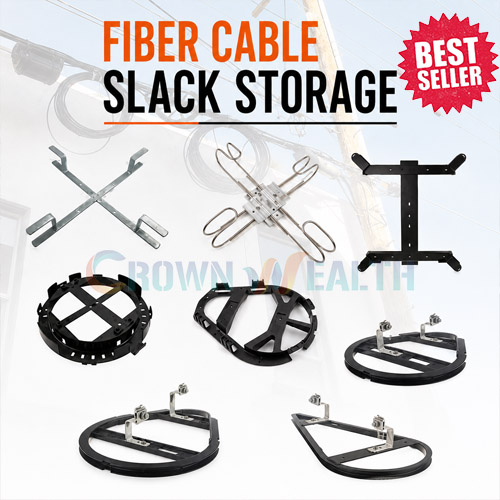
- Cable slack storage
- Down-lead clamps
- Anchor hardware
By selecting compatible components, you can create a more consistent aerial fiber installation system.
Where Do You Use a J Hook Suspension Clamp?
You mainly use a J Hook Suspension Clamp at intermediate support points on aerial fiber optic cable routes.
Common applications include the following.
Telecom Utility Poles
You can mount the clamp on wooden, steel, or concrete poles through suitable pole attachment hardware.
The clamp then supports the ADSS cable as it continues along the telecom route.
ADSS Fiber Optic Networks
ADSS cable is specifically designed for self-supporting aerial installation.
Therefore, you need suitable suspension and dead-end hardware to manage the cable at different pole positions.
J suspension clamps provide one solution for intermediate support.
FTTH Infrastructure
Although drop cables typically use smaller drop wire clamps, larger ADSS cables can form backbone or distribution sections of an FTTH network.
In these areas, you can use suspension hardware to support aerial fiber routes between poles.
Rural Broadband Networks
Rural fiber projects often require long aerial routes across utility poles.
Reliable suspension hardware helps you organize and support the cable along these routes.
Industrial and Utility Communication Networks
Factories, mines, utilities, rail infrastructure, and other industrial facilities may use aerial fiber networks for communication and monitoring.
J hook suspension clamps can form part of these pole-mounted cable systems.
Suspension Clamp vs. Tension Clamp: What Is the Difference?
One important purchasing decision is determining whether you need a suspension clamp or a tension clamp.
They perform different functions.
| Feature | Suspension Clamp | Tension Clamp |
|---|---|---|
| Main function | Supports cable | Anchors and tensions cable |
| Typical location | Intermediate pole | Dead end or tension point |
| Cable route | Cable continues past pole | Cable is mechanically terminated |
| Load type | Mainly suspension/support | Higher longitudinal tension |
| Common product | J Hook Suspension Clamp | ADSS tension clamp / dead-end grip |
You should not substitute one for the other without considering the network engineering requirements.
At an intermediate pole with a relatively straight cable route, you may use a suspension clamp.
At a cable termination, major angle change, or tension point, you normally need suitable dead-end or tension hardware.
How to Choose the Right J Hook Suspension Clamp
Before placing an order, you should confirm several technical factors.
1. Check the Cable Diameter
Start with the outside diameter of your ADSS cable.
The clamp must fit the cable correctly.
If the cable is too small or too large for the rubber insert, the clamp may not provide the intended support.
Therefore, send the exact cable diameter to your supplier.
2. Confirm Single or Double Cable Installation
Determine whether you need to support:
- One ADSS cable
- Two parallel ADSS cables
If you have two cables following the same pole route, a double J suspension clamp may provide a more compact solution.
3. Check the Cable Span
Cable span affects mechanical loading.
A short-span distribution network and a long-span aerial route can place very different loads on the suspension hardware.
Therefore, provide the span length when requesting a quotation.
4. Confirm Mechanical Load Requirements
Do not select a suspension clamp based only on appearance or cable diameter.
You should also confirm:
- Vertical load
- Cable tension
- Pole spacing
- Installation angle
- Environmental loading
- Project safety requirements
For engineering projects, provide the required mechanical specifications to your manufacturer.
5. Check the Installation Angle
A cable does not always pass through every pole in a perfectly straight line.
If the route changes direction, the suspension point experiences additional loading.
Therefore, you should confirm the permissible line angle for the selected clamp according to your project specification.
6. Check the Material
For outdoor applications, verify the materials used for both the support frame and the cable-contact area.
For example, you may specify galvanized steel for structural components and UV-resistant rubber or neoprene for the cable cushion.
7. Confirm the Mounting Method
You also need to know how you will attach the clamp to the pole.
Depending on your system, you may use:
- Pole bolts
- Pole brackets
- Stainless steel banding
- Mounting plates
- Other telecom pole hardware
Confirm compatibility before mass purchasing.
How to Install a J Hook Suspension Clamp
The exact installation procedure depends on the clamp and pole system, but the basic process generally follows several steps.
First, inspect the clamp and confirm that its size matches the ADSS cable.
Next, install the J hook assembly onto the appropriate pole bracket or mounting point.
Then, position the cable correctly inside the protective support section.
After that, close or secure the clamp according to its design.
Finally, inspect the completed installation.
You should check that:
- The cable sits naturally inside the clamp
- The rubber insert contacts the cable correctly
- The cable is not excessively compressed
- The clamp is securely attached
- The cable does not exceed the permitted bend radius
- The line angle matches the design requirements
- All mounting hardware is tightened correctly
Always follow the engineering requirements for your specific ADSS cable system.
What Information Should You Send to a Suspension Clamp Manufacturer?
If you want an accurate quotation, provide more than a product photo.
You should send your supplier:
- ADSS cable diameter
- Number of cables
- Cable construction
- Span length
- Required mechanical load
- Line angle
- Clamp drawing or reference photo
- Required steel finish
- Rubber material requirements
- Quantity
- Packaging requirements
- Destination country
- Applicable project standard
For a customized project, you can also provide a sample or technical drawing.
This helps the manufacturer evaluate compatibility before production.
Common Mistakes When Choosing ADSS Suspension Hardware
You can avoid many installation problems by checking the application before ordering.
One common mistake is choosing a clamp only according to price.
Another is assuming that all ADSS cables with a similar appearance use the same hardware.
In reality, cable diameter, jacket construction, span, tension, and route conditions can vary significantly.
You should also avoid using a suspension clamp where the design requires a dead-end clamp.
Most importantly, match the hardware to the cable manufacturer’s and network engineer’s requirements.
Hbcrownwealth J Hook Suspension Clamps
Hebei Crown Wealth is professional manufacturer & supplier of electrical hardwares. Wholesale aerial drop hardware, pole line hardware, stainless steel banding strap, ADSS & OPGW cable accessories, cable attachment, underground cable management. We provide you with factory price and quality assurance. If you have interested in our products. please feel free to contact us.
Frequently Asked Questions About J Hook Suspension Clamps
What is a J Hook Suspension Clamp?
A J Hook Suspension Clamp is pole-mounted hardware used to support ADSS fiber optic cables at intermediate points along an aerial cable route.
What is a double cable J suspension clamp?
A double cable J suspension clamp supports two ADSS cables within one suspension assembly. It can help you organize parallel aerial fiber routes and reduce separate pole hardware.
What cable does a J hook suspension clamp support?
These clamps are commonly used with ADSS fiber optic cables. However, you must select the correct model according to cable diameter and mechanical requirements.
What is the difference between a suspension clamp and a dead-end clamp?
A suspension clamp supports a cable at an intermediate point, while a dead-end or tension clamp mechanically anchors the cable at a termination or tension point.
Why does a suspension clamp use rubber or neoprene?
The protective insert provides a softer contact surface between the clamp and cable. It helps distribute pressure and reduce abrasion or concentrated mechanical stress on the cable jacket.
Can you use a J suspension clamp outdoors?
Yes, models designed with galvanized steel and UV-resistant cable-support materials are intended for outdoor aerial installations. Always confirm the exact environmental requirements for your project.
How do I choose the right J Hook Suspension Clamp?
You should check cable diameter, number of cables, span length, mechanical load, installation angle, mounting method, material, and project specifications before ordering.