English
 Spanish
 French
 Arabic
Stainless steel banding straps are widely used when you need a strong, durable, and corrosion-resistant fastening solution. You can use stainless steel banding to secure cables, signs, pipes, insulation, equipment, brackets, and other components in industrial, construction, utility, marine, and outdoor applications.
However, not all stainless steel banding is the same.
The final performance depends on several factors, including the stainless steel grade, strip thickness, width tolerance, edge quality, tensile strength, surface condition, and manufacturing process.
The three most common material options are 201, 304, and 316 stainless steel. Each grade offers a different balance between cost, mechanical performance, and corrosion resistance.
In this guide, you will learn how stainless steel banding straps are manufactured, how 201, 304, and 316 stainless steel differ, and which material and international standard you should consider for different markets and environments.
What Is a Stainless Steel Banding Strap?
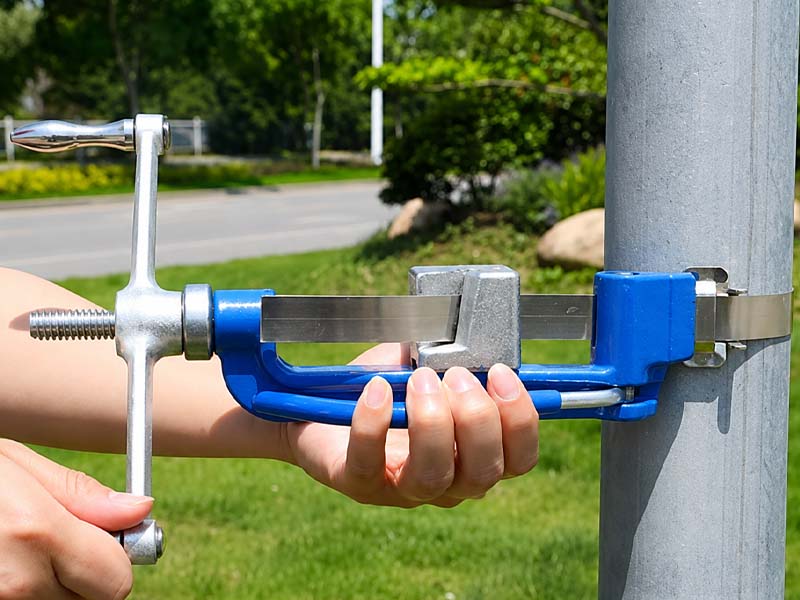
A stainless steel banding strap is a narrow strip of stainless steel that you tension around an object and secure with a buckle, clip, seal, or fastening tool.
Unlike ordinary carbon steel strapping, stainless steel banding provides much better resistance to moisture, weathering, oxidation, and many corrosive environments.
Depending on your project, you can select different widths, thicknesses, tensile properties, surface finishes, edge conditions, and stainless steel grades.
The Manufacturing Process of Stainless Steel Banding Straps
Producing reliable stainless steel banding straps requires more than simply cutting a stainless steel coil into narrow strips. You need accurate material control, precision slitting, smooth edges, consistent mechanical properties, and careful inspection throughout production.
A typical manufacturing process includes the following stages:
1. Raw Material Selection and Inspection – Manufacturing begins with stainless steel coil. Depending on your application, the manufacturer selects 201, 304, or 316 stainless steel.
2. Precision Slitting – The wide stainless steel coil is fed into a precision slitting line and divided into narrower strips.
3. Edge Conditioning and Deburring – After slitting, the edges may contain small burrs. Therefore, the manufacturer smooths or conditions the edges according to the required specification.
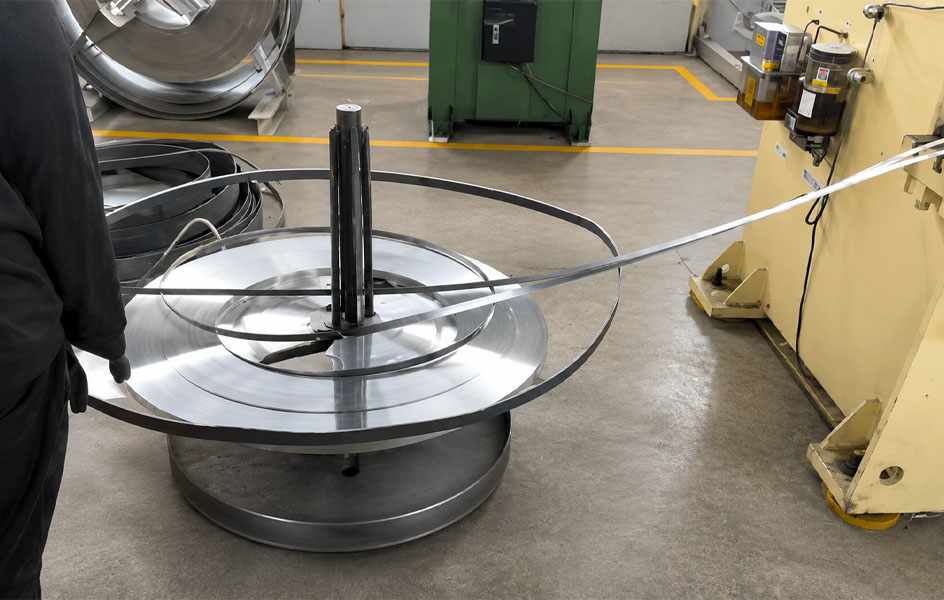
4. Thickness and Mechanical Property Control – The manufacturer then controls thickness, hardness, tensile strength, and elongation according to the required application.
5. Surface Cleaning and Finishing – The stainless steel surface must remain clean and consistent. Depending on the specification, the band may use a bright, 2B, or other cold-rolled finish.
6. Optional Punching or Special Processing – Standard stainless steel banding normally uses a solid strip. However, if you need perforated banding, identification marks, special holes, or customized profiles, an additional stamping or punching stage can be added. The tooling must maintain accurate spacing while avoiding excessive deformation of the strip.
7. Recoiling and Packaging – After processing, the finished stainless steel strap is wound into coils. Depending on your requirements, the manufacturer can produce compact rolls, larger industrial coils, or banding packed inside dispensing boxes. Controlled winding helps the strap feed smoothly during installation and prevents twisting or edge damage.
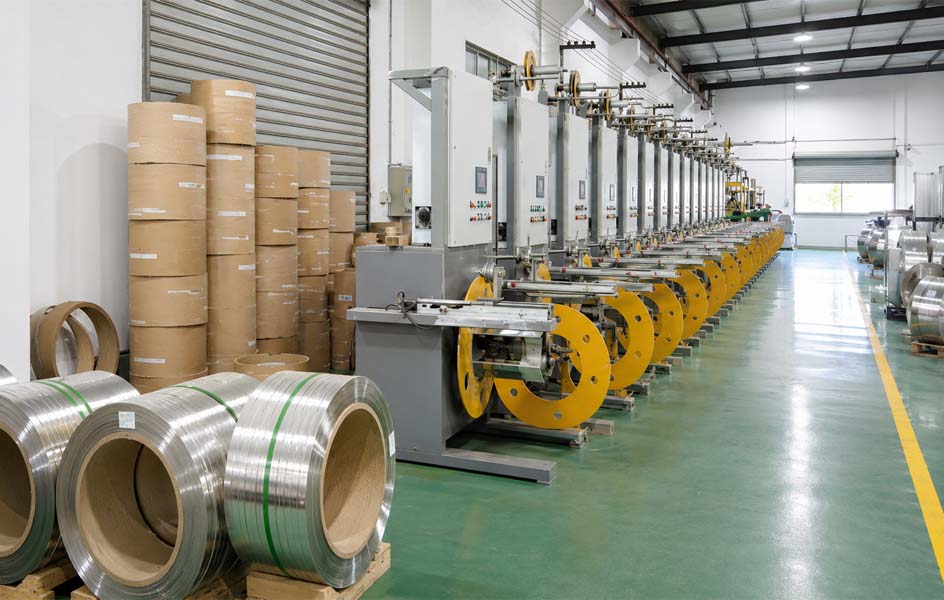
8. Final Quality Inspection – Before shipment, the manufacturer checks the finished banding for width, thickness, coil length or weight, edge condition, surface quality, mechanical performance, and material grade. For international projects, the buyer may also request material certificates, chemical analysis, tensile testing, dimensional reports, or other inspection documents.
201 vs. 304 vs. 316 Stainless Steel Banding
The material grade has a major influence on the cost and corrosion resistance of your stainless steel strapping.
The simplest way to understand the difference is:
201 = economical stainless steel for lower-corrosion environments
304 = general-purpose stainless steel for most industrial and outdoor applications
316 = higher corrosion resistance for coastal, marine, chloride, and demanding industrial environments
201 Stainless Steel Banding
201 stainless steel is an austenitic chromium-manganese stainless steel with lower nickel content than conventional 304 stainless steel.
Part of the nickel is replaced by manganese. As a result, you can reduce material cost while maintaining useful strength and formability.
The internationally recognized designations include:
| Standard system | 201 designation |
|---|---|
| ASTM / AISI type | 201 |
| UNS | S20100 |
| European EN designation | 1.4372 |
Outokumpu identifies Type 201 / UNS S20100 / EN 1.4372 as a low-nickel Cr-Mn austenitic stainless steel and notes that its corrosion resistance is generally somewhat below standard Cr-Ni grades such as 304.
304 Stainless Steel Banding
For most buyers, 304 stainless steel banding provides the best balance between price, corrosion resistance, mechanical performance, and worldwide availability.
304 is the classic chromium-nickel austenitic stainless steel. It is widely used for indoor and outdoor equipment, construction, food equipment, containers, cladding, and many general industrial applications.
Its common international equivalents are:
| Standard system | 304 designation |
|---|---|
| ASTM / AISI type | 304 |
| UNS | S30400 |
| European EN designation | 1.4301 |
| Japanese designation | SUS304 |
Outokumpu describes 304 / 1.4301 / UNS S30400 as an all-purpose stainless steel with good corrosion resistance, formability, and weldability.
316 Stainless Steel Banding
When corrosion resistance becomes the priority, you should consider 316 stainless steel banding.
316 contains molybdenum, which gives it better resistance in demanding corrosive environments than standard 304 stainless steel.
Common designations include:
| Standard system | 316 designation |
|---|---|
| ASTM / AISI type | 316 |
| UNS | S31600 |
| European EN designation | 1.4401 |
| Japanese designation | SUS316 |
Outokumpu describes Type 316 / UNS S31600 / EN 1.4401 as a molybdenum-alloyed stainless steel intended for applications with higher-than-average corrosion-resistance requirements.
Which Stainless Steel Banding Grade Should You Use in Different Countries?
Country alone does not determine the correct stainless steel grade.
For example, an indoor project in Miami and an outdoor installation directly beside the ocean have completely different corrosion conditions even though both are in the United States.
Therefore, you should first consider the actual environment and then specify the standard commonly accepted in your target market.
The following table provides a practical export purchasing guide.
| Market | Common specification for stainless strip | Typical grade choice |
|---|---|---|
| United States | ASTM A240/A240M, ASTM A666/A666M | 304 for general use; 316 for coastal, marine and chloride environments; 201 for economical low-corrosion applications |
| Canada | ASTM specifications are commonly used for imported stainless banding | 304 general; 316 for coastal areas, industrial exposure and applications affected by deicing salts |
| European Union | EN 10088-2 | 1.4372 / 201 for lower-corrosion applications; 1.4301 / 304 for general use; 1.4401 / 316 for aggressive environments |
| United Kingdom | EN 10088-2 specifications remain commonly recognized in stainless procurement | 304 general; 316 preferred in coastal and higher-corrosion locations |
| Japan | JIS G 4305 for cold-rolled stainless steel plate, sheet and strip | SUS304 for general applications and SUS316 for demanding corrosion environments |
| China | GB/T 3280-2015 | 201, 304 or 316 according to environment and customer specification |
| India | IS 6911 and international ASTM specifications | 304 for general projects; 316 for marine/chemical environments; economy grades only when the buyer specification permits |
| Australia | ASTM A240/A240M is widely used for imported stainless flat products | 304 for general inland installations; 316 commonly preferred near the coast |
ASTM A240 explicitly covers stainless steel plate, sheet and strip, while EN 10088-2 is widely referenced for European stainless flat products. Japan’s JIS G 4305 specifically covers cold-rolled stainless plate, sheet and strip, and China’s current national standard for cold-rolled stainless plate, sheet and strip is GB/T 3280-2015.
Australia is a useful example of why you should distinguish between a country’s historical national standard and the specification actually used in trade. The Australian Stainless Steel Development Association notes that ASTM A240/A240M has become a commonly available specification for imported stainless flat products in Australia.
Stainless Steel Banding for the USA and Canada
If you are purchasing stainless steel strapping for the United States or Canada, ASTM specifications are usually an important reference.
ASTM A240/A240M covers chromium, chromium-nickel, and chromium-manganese-nickel stainless steel plate, sheet, and strip for general applications.
For most standard outdoor installations, 304 stainless steel banding provides a good balance.
However, you should consider 316 stainless steel for coastal areas, offshore projects, locations with salt exposure, chemical environments, or installations that experience significant winter road salt.
A Canadian stainless steel banding supplier, for example, specifies ASTM A240 for stainless banding manufactured from T304/T304L and T316/T316L alloys.
For dry, protected and cost-sensitive applications, 201 can also be considered when the project specification accepts it.
Stainless Steel Banding for Europe
For buyers in Germany, France, Italy, Spain, the Netherlands and other European markets, you will frequently encounter EN 10088-2 material designations.
You can generally match the grades as follows:
201 → EN 1.4372
304 → EN 1.4301
316 → EN 1.4401
These equivalencies are documented by stainless steel producers for EN and ASTM material systems.
For typical construction and industrial use, you can start with 304 / 1.4301.
For coastal projects, chemical plants and installations with higher chloride exposure, 316 / 1.4401 gives you additional corrosion resistance.
Stainless Steel Banding for Japan
Japanese customers commonly reference JIS G 4305 for cold-rolled stainless steel plate, sheet, and strip.
The standard includes grades such as SUS304 and SUS316, and it defines requirements for cold-rolled stainless flat products.
Therefore, when you export banding to Japan, you should confirm whether the customer requires a specific JIS grade designation, dimensional tolerance, surface finish, or inspection document before production.
For general applications, SUS304 is usually the more practical option, while SUS316 suits applications requiring higher corrosion resistance.
Stainless Steel Banding for Coastal and Tropical Countries
For countries and regions with high humidity or strong marine exposure, material selection becomes especially important.
This includes applications in countries such as Singapore, Malaysia, Indonesia and the Philippines, as well as coastal areas of Australia, the United States and Middle Eastern markets.
In sheltered environments, 304 may provide sufficient performance.
However, when your stainless steel banding sits close to seawater, salt spray or high chloride concentrations, 316 stainless steel is normally the better technical choice because its molybdenum alloying improves corrosion resistance compared with standard 304.
You should still follow the purchaser’s project specification because many international projects use ASTM or EN standards even when the installation country has its own national standards.
How to Choose Between 201, 304 and 316 Stainless Steel Banding
A simple purchasing rule is:
| Your application | Recommended material |
|---|---|
| Dry, indoor, sheltered, cost-sensitive | 201 |
| General outdoor and industrial use | 304 |
| Coastal, marine, salt, chloride or aggressive industrial environment | 316 |
However, do not select the material based on price alone.
You should also evaluate the required band width, thickness, tensile strength, elongation, edge condition, buckle type, installation tool, operating temperature, expected service life and local environment.
A slightly higher material cost can save you significantly more if it prevents premature corrosion or replacement.
Hbcrownwealth — Professional Stainless Steel Banding Manufacturer in China
Hbcrownwealth is a professional stainless steel banding strap manufacturer in China.
We manufacture and supply stainless steel banding solutions for overseas distributors, wholesalers, contractors, industrial buyers, and project customers.
You can select 201, 304, or 316 stainless steel banding according to your target market, operating environment, project specification, and budget. More importantly, we help you choose a suitable material instead of simply supplying the lowest-cost grade.
If you need stainless steel banding for general industrial use, 304 may provide the right balance between cost and durability. If your project is located in a marine, coastal, or highly corrosive environment, we can recommend 316 stainless steel. For lower-corrosion and cost-sensitive applications, 201 stainless steel can provide another option.
Whether you call the product stainless steel banding straps, stainless steel banding, stainless steel strapping, or stainless steel fixing bands, Hbcrownwealth can work with you to determine the appropriate material, dimensions, packaging, and project requirements.
Frequently Asked Questions About Stainless Steel Banding Straps
Q1. What is the best stainless steel for banding straps?
304 stainless steel is generally the best all-purpose choice because it provides a good balance of corrosion resistance, availability, strength, and cost. For marine or high-chloride environments, choose 316. For dry and less corrosive applications where cost is important, consider 201.
Q2. Is 201 stainless steel banding suitable for outdoor use?
It can be used in relatively mild and low-corrosion environments, but its corrosion resistance is lower than standard Cr-Ni grades such as 304. Therefore, you should choose 304 or 316 when long-term outdoor corrosion resistance is important.
Q3. What is the difference between 304 and 316 stainless steel banding?
316 stainless steel contains molybdenum and is designed for higher corrosion-resistance requirements. Therefore, it is generally more suitable for marine, coastal, chloride-rich, and aggressive industrial environments than standard 304.
Q4. What standard applies to stainless steel banding in the United States?
ASTM A240/A240M is one of the key material specifications for stainless steel plate, sheet, and strip and covers chromium, chromium-nickel, and chromium-manganese-nickel stainless steels for general applications.
Q5. What European grades correspond to 201, 304 and 316?
Common equivalents are 201 = EN 1.4372, 304 = EN 1.4301, and 316 = EN 1.4401.