English
 Spanish
 French
 Arabic
When you build or maintain an overhead power line, telecom line, or guy wire system, every connection point must handle tension reliably. A thimble eye bolt provides a strong attachment point for guy wires, preformed dead ends, strand, and other pole line hardware.
Unlike a standard eye bolt, a thimble eye bolt features a specially shaped eye with a curved groove. This design gives the connected wire or grip a smoother bearing surface, reduces sharp bending, and helps distribute mechanical loads more effectively.
In this guide, you will learn what a thimble eye bolt is, how it works, where you can use it, the main types and sizes available, and how to choose the right model for your overhead line project.
What Is a Thimble Eye Bolt?
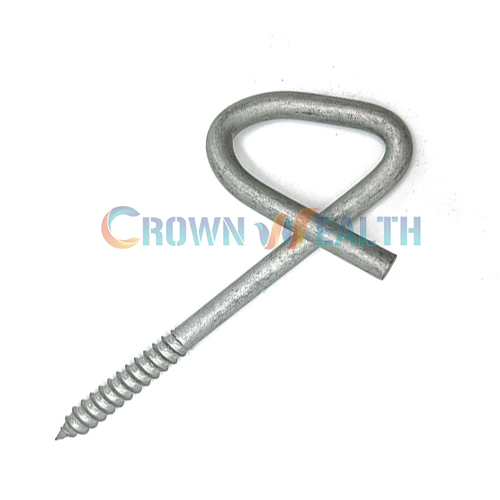
A thimble eye bolt is a pole line hardware fitting with a threaded shank and a reinforced, grooved eye designed to connect guy wires, preformed grips, and other tension hardware to poles, crossarms, brackets, or structural supports.
The eye section resembles a cable thimble. Its curved profile supports the connected wire or fitting over a wider area instead of forcing it around a small-radius bend.
As a result, you can use a thimble eye bolt to create a secure and durable tension connection in overhead electrical and telecommunications systems.
Most thimble eye bolts use high-strength steel and receive a hot-dip galvanized finish to improve corrosion resistance in outdoor environments.
What Is a Thimble Eye Bolt Used For?
You mainly use a thimble eye bolt when an overhead line system requires a strong anchoring or tension point.
Typical applications include:
- Guy wire connections
- Stay wire systems
- Utility pole guying
- Preformed guy grip connections
- Dead-end assemblies
- Overhead power distribution lines
- Telecommunications lines
- Cable support structures
- Crossarm connections
- Pole-mounted tension hardware
For example, you can install a thimble eye bolt through a utility pole, crossarm, or steel bracket. Then, you can connect a preformed guy grip or guy wire assembly to the thimble-shaped eye.
The bolt transfers the tension from the guying system into the supporting structure.
Therefore, the thimble eye bolt plays an important role in maintaining pole stability and mechanical reliability.
How Does a Thimble Eye Bolt Work?
A thimble eye bolt works by creating a reinforced connection between the supporting structure and the tensioned guy wire or line fitting.
The basic connection usually follows this load path:
Guy Wire → Preformed Guy Grip or Strand → Thimble Eye → Bolt Shank → Pole or Supporting Structure
The curved thimble-shaped eye provides an important advantage.
Instead of allowing the guy wire or preformed grip to bend sharply around a small contact point, the eye creates a broader and smoother load-bearing surface.
This can help:
- Reduce concentrated stress
- Minimize sharp bending
- Reduce abrasion at the connection point
- Improve load distribution
- Support stable tension connections
- Extend the service life of connected hardware
This is one reason why thimble eye bolts are commonly used in guying and dead-end applications.
Main Types of Thimble Eye Bolts
Although designs vary between manufacturers and utility specifications, you will commonly find two major configurations: straight thimble eye bolts and angled thimble eye bolts.
1. Straight Thimble Eye Bolt
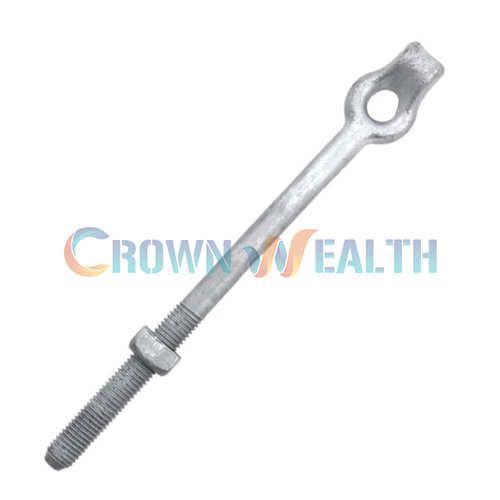
A straight thimble eye bolt has the thimble-shaped eye aligned with the bolt shank.
You can use this design when the direction of the applied load aligns relatively closely with the bolt installation position.
Straight thimble eye bolts are commonly used for:
- Guy wire systems
- Pole line hardware assemblies
- Dead-end connections
- Crossarm applications
- Telecommunications support systems
The simple straight configuration makes installation convenient and allows the bolt to integrate easily with many standard pole line assemblies.
2. Angled Thimble Eye Bolt
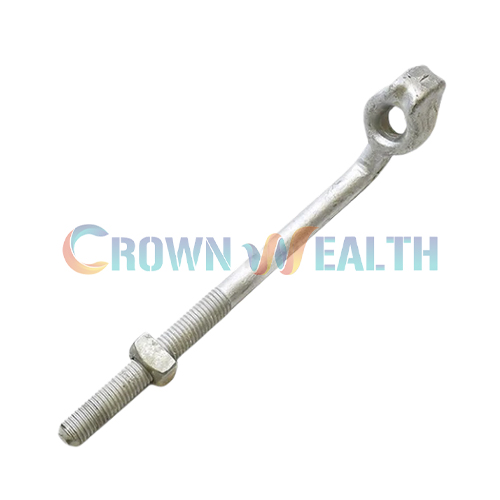
An angled thimble eye bolt positions the thimble eye at an angle relative to the shank.
This configuration can help align the eye more naturally with the direction of the guy wire or tension force.
You may choose an angled model when the guy wire approaches the pole or structure from a different direction and a straight eye would create an undesirable loading angle.
Angled thimble eye bolts can help improve alignment between:
- Guy wire
- Preformed grip
- Eye connection
- Supporting structure
However, you should always select the angle according to the actual engineering design and loading direction.
Straight vs. Angled Thimble Eye Bolt
The main difference between straight and angled thimble eye bolts is the orientation of the eye.
| Feature | Straight Thimble Eye Bolt | Angled Thimble Eye Bolt |
|---|---|---|
| Eye position | In line with shank | Eye positioned at an angle |
| Typical use | General guying and tension connections | Applications requiring directional alignment |
| Installation | Simple and versatile | Depends more on load direction |
| Guy wire alignment | Suitable for relatively direct pull | Better for certain angled pull conditions |
| Common industries | Power and telecom | Power and telecom |
You should not choose between them based only on appearance.
Instead, consider the direction of the mechanical load, pole configuration, guy wire angle, and project specification.
Common Thimble Eye Bolt Sizes
Thimble eye bolts come in different diameters, shank lengths, thread lengths, and eye dimensions.
There is no single universal size for every project.
When you select a thimble eye bolt, you normally need to confirm several dimensions.
Bolt Diameter
Bolt diameter affects the mechanical capacity of the connection and determines which hole, nut, washer, or bracket you can use.
Utility buyers commonly specify bolt diameters in either metric or imperial dimensions.
Overall Length
You should choose the bolt length according to the thickness of the pole, crossarm, bracket, or other structure it must pass through.
A longer bolt does not automatically mean a better bolt.
Instead, the length should provide sufficient installation allowance while avoiding unnecessary protrusion.
Thread Length
You need enough usable thread for the nut and washer to tighten securely.
Therefore, you should check both the overall bolt length and the effective thread length before ordering.
Eye Size
The thimble eye must match the connected guy grip, strand, or other fitting.
If the eye is too small or its groove does not suit the connected hardware, the system may not achieve the intended load distribution.
Thread Specification
You should also confirm:
- Metric or imperial thread
- Thread diameter
- Thread pitch
- Thread length
- Nut requirements
For export orders, these details become especially important because different markets and utilities may use different standards.
What Materials Are Used for Thimble Eye Bolts?
Manufacturers commonly produce thimble eye bolts from carbon steel or other suitable structural steels.
The material must provide enough strength for the intended mechanical load.
Depending on the manufacturing process, the eye section may be forged or otherwise formed to create the required thimble profile.
For outdoor electrical infrastructure, manufacturers usually apply a protective coating after forming and machining.
Why Is Hot-Dip Galvanizing Important?
A hot dip galvanized thimble eye bolt receives a zinc coating that protects the underlying steel against corrosion.
This is especially important because utility hardware often remains outdoors for many years.
It may face:
- Rain
- Humidity
- Temperature changes
- Coastal air
- Industrial environments
- Soil moisture
- Long-term outdoor exposure
Without suitable corrosion protection, rust can gradually affect the surface and potentially reduce the service life of the hardware.
Therefore, hot-dip galvanizing is widely used for overhead line fittings.
When your project requires a specific galvanizing standard or coating thickness, you should include that requirement in your RFQ.
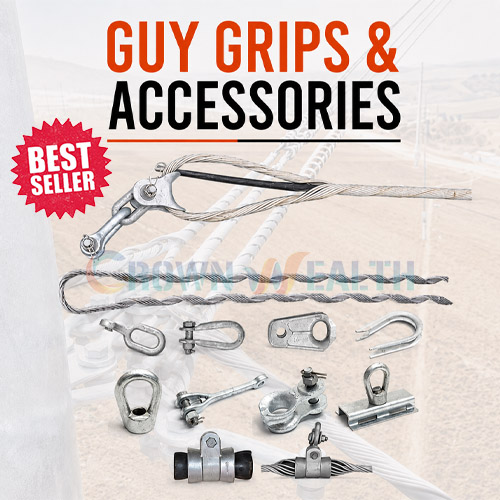
Thimble Eye Bolt and Preformed Guy Grip Connection
One of the most common applications involves a preformed guy grip.
A preformed guy grip wraps around the guy strand and forms a loop at the termination point.
You can position this loop around the thimble eye.
The thimble-shaped groove then supports the loop and helps maintain a suitable bending radius.
This combination creates a practical tension connection for many pole guying systems.
A typical assembly may include:
Utility Pole + Thimble Eye Bolt + Preformed Guy Grip + Guy Wire + Anchor Hardware
Because each component transfers part of the mechanical load, you should make sure all fittings are compatible with one another.
How to Choose the Right Thimble Eye Bolt
You should not select a thimble eye bolt based on price or dimensions alone.
Instead, check the complete application.
1. Confirm the Application
First, determine where you will install the bolt.
For example:
- Utility pole
- Crossarm
- Steel structure
- Telecom pole
- Guying assembly
- Dead-end system
The application determines the required configuration.
2. Check the Load Direction
Next, determine the direction of the tension force.
This will help you decide whether you need a straight or angled thimble eye bolt.
Good alignment helps the connected hardware transfer loads more naturally.
3. Confirm the Bolt Diameter
Choose a diameter that matches the supporting structure and engineering requirements.
You should also confirm that the mounting hole, washer, and nut match the bolt.
4. Determine the Required Length
Measure the thickness of the pole, crossarm, plate, or bracket.
Then allow enough additional length for washers, nuts, and proper tightening.
5. Check the Thimble Eye Dimensions
Make sure the eye can accommodate the guy grip, strand, or other connecting hardware.
You should pay particular attention to:
- Eye opening
- Groove width
- Groove radius
- Eye thickness
6. Check Material and Mechanical Requirements
Ask your supplier to confirm the steel grade and relevant mechanical properties when your project specification requires them.
For critical utility projects, you may also need factory test reports or third-party inspection.
7. Specify the Surface Finish
For most outdoor applications, hot-dip galvanizing provides practical corrosion protection.
However, you should clearly state any required galvanizing standard, coating specification, or inspection requirement in your purchase documents.
Hbcrownwealth Thimble Eye Bolts and Pole Line Hardware
Hbcrownwealth supplies thimble eye bolts and other pole line hardware for overseas distributors, utilities, contractors, and infrastructure projects.
You can source different configurations according to your project requirements, including straight and angled thimble eye bolt designs.
In addition, Hbcrownwealth supplies related overhead line hardware such as:
- Eye bolts
- Preformed guy grips
- Stay rods
- Guy clamps
- Crossarm pins
- Anchor hardware
- Pole bands
- Suspension hardware
- Utility line fasteners
If your project requires specific dimensions, galvanizing, packaging, or OEM production, you can provide your drawing or technical specification for evaluation.
Frequently Asked Questions About Thimble Eye Bolts
What is a thimble eye bolt?
A thimble eye bolt is a threaded pole line fitting with a grooved, thimble-shaped eye. You use it to connect guy wires, preformed grips, and other tension hardware to poles or supporting structures.
What is the main purpose of a thimble eye?
The thimble-shaped eye provides a wider curved surface for the connected wire or fitting. This helps reduce sharp bending, local stress, and wear at the connection point.
Where are thimble eye bolts used?
You can use them in overhead power lines, telecom networks, guy wire systems, utility poles, crossarms, and dead-end assemblies.
What is the difference between a straight and angled thimble eye bolt?
A straight model aligns the eye with the bolt shank, while an angled model positions the eye at an angle to suit certain load directions and guy wire configurations.
Are thimble eye bolts galvanized?
Many thimble eye bolts for outdoor utility applications are hot-dip galvanized to improve corrosion resistance. You should confirm the required coating specification with your supplier.
Can a thimble eye bolt connect to a preformed guy grip?
Yes. Preformed guy grips commonly connect to thimble-style eyes in guying systems, provided the dimensions and load requirements are compatible.
How do I choose the correct thimble eye bolt size?
Check the bolt diameter, overall length, thread dimensions, eye dimensions, guy wire or fitting size, load direction, mechanical requirements, and surface finish before ordering.