English
 Spanish
 French
 Arabic
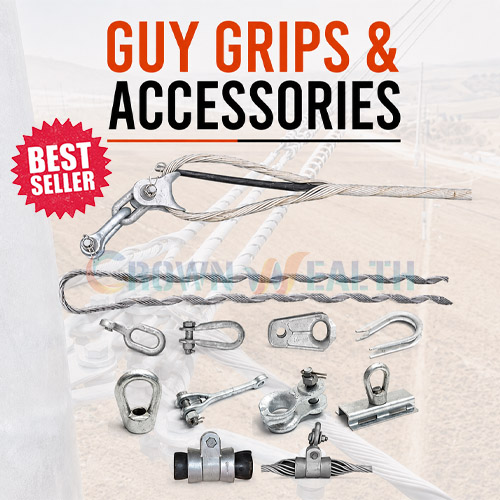
Extreme weather like hurricane-force gales and icing places severe dynamic tension on overhead utility lines. When a single guy strand slips or snaps, sudden tension loss causes instant pole buckling and catastrophic grid blackouts. Specifying high-performance guy grips is your primary defense against storm-induced infrastructure collapse.

Extreme Weather Challenges for Overhead Line Tensioning
Overhead lines in coastal, mountainous, or storm-prone regions operate under continuous environmental degradation. If you rely on standard line hardware that only performs well in mild climates, your equipment will fail prematurely when severe weather hits:
-
Dynamic Wind Loading & Mechanical Fatigue: High-velocity gusts exert massive peak forces on your guy wires. Furthermore, continuous lower-velocity winds generate destructive high-frequency line vibrations (aeolian vibration and galloping). Over time, these dynamic cyclic forces wear down rigid, bolt-based mechanical clamps.
-
Coastal Salt Spray & Severe Atmospheric Corrosion: If you operate in C4 or C5 marine environments, fine salt fog and elevated humidity penetrate hardware connection points. Sub-standard steel fittings undergo rapid oxidation, pitting corrosion, and hydrogen embrittlement, drastically reducing your load-bearing safety margins.
-
Thermal Expansion & Cable Contraction: Sharp temperature swings between summer heat and freezing winter conditions force your guy wires to expand and contract continuously. Your hardware must maintain an unyielding tension without loosening or slipping over decades of thermal cycling.
How Material & Manufacturing Quality Impacts Guy Grip Performance
You must recognize that not all helical wire fittings are manufactured to the same engineering standard. The ultimate holding strength of your preformed guy grips depends entirely on raw material selection, manufacturing precision, and surface friction treatment.
HIGH-CARBON GALVANIZED STEEL / ACS WIRE (Provides Tensile Strength matching your Wire Strand RTS)
↓
INTERNAL SANDING / GRIT COATING (Enhances Friction Coefficient without Pinching)
↓
PRECISION HELICAL PITCH FORMING (Uniform 360° Stress Distribution over Whole Length)
High-Tensile Galvanized & Aluminum-Clad Steel Wires
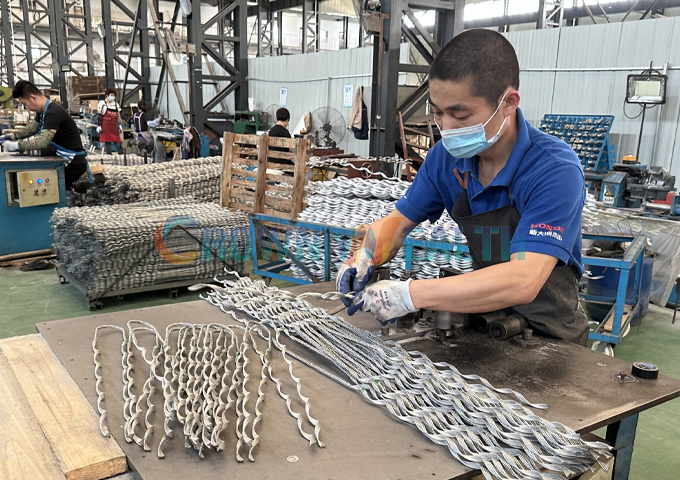
You need dead-end fittings that utilize premium high-carbon steel cores to absorb sudden tensile surges without permanent deformation. Depending on your installation environment:
-
Hot-Dip Galvanized (HDG) Steel: You should insist on heavy zinc coatings complying with ASTM A153 to ensure long-term resistance to atmospheric rust.
-
Aluminum-Clad Steel (ACS): You must specify ACS fittings for aggressive coastal environments where you need to eliminate galvanic corrosion between dissimilar metals.
Internal Sanding & Grit Coating (Grit Treatment)
When you inspect the inner loop and legs of high-grade guy grip dead ends, you will notice a specialized interior grit coating embedded with abrasive silicon carbide granules. This grit drastically increases the friction coefficient against your guy wire, locking the fitting in place during extreme wind gusts without damaging the individual outer strands.
Precision Pitch & Helical Forming

Cold-forming helical legs with exact pitch consistency ensures that every coil wraps around your wire with equal radial pressure. Poorly formed helical legs create localized pressure spikes that weaken your guy wire over time.
Structural Superiority: Guy Grip Dead Ends vs. Traditional Mechanical Clamps
For decades, line crews relied on traditional 3-bolt guy clamps. However, modern utility standards recommend upgrading to preformed dead end guy grips due to their superior tension distribution mechanism.
| Feature / Metric | Traditional 3-Bolt Guy Clamps | Preformed Guy Grips / Dead Ends |
| Stress Distribution | Concentrated at 2–3 bolt clamping points | Distributed evenly over 360 degrees along entire length |
| Rated Holding Strength | ~75%–85% of strand Rated Breaking Load | Up to 100% of guy strand Rated Tensile Strength (RTS) |
| Installation Method | Requires torque wrenches & manual adjustment | Tool-free manual wrap; eliminates human torquing error |
| Fatigue Resistance | High risk of localized wire pinching & fatigue | Excellent vibration damping & uniform stress absorption |
| Corrosion Hazard | Exposed bolt threads prone to rust and seizure | Smooth, continuous wire design with uniform coating |
By wrapping smoothly around your guy strand, guy grips eliminate the localized pinch-points caused by bolt compression. This 360-degree holding action guarantees that your line retains its full tensile rating even during severe dynamic swaying.

Key Engineering Selection Criteria for Preformed Dead End Guy Grips
To maximize line security in high-wind zones, your procurement and engineering teams should evaluate three critical technical criteria:
-
Exact Wire Strand Diameter Matching: Precision-engineered fittings correspond to exact wire sizes (e.g., 5/16″, 3/8″, 7/16″). You must never install a grip on an improperly matched wire diameter.
-
Color-Coding Identification System: High-quality manufacturers apply durable color bands at the crossover mark and leg tips. This enables your field crews to instantly verify size compatibility on-site and locate the precise starting point for wrapping.
-
Direction of Lay Matching: Guy wire strands are twisted in either Right-Hand Lay (RHL) or Left-Hand Lay (LHL). You must ensure your preformed dead end guy grips match the exact lay direction of your guy strand to achieve full contact along the helical grooves.
Internal Link Reference: To learn more about matching line hardware with your project requirements, explore our guide on How to Choose the Right Guy Grip for Power and Telecom Projects.
Quality Assurance Checklist for Procurement
Before you issue your next purchase order for line hardware, use this checklist to verify supplier quality:
Raw Material Certification: Check high-carbon steel wire mill certificates and verify zinc coating mass per ASTM standards.
Internal Grit Density: Inspect the inner leg surface to ensure uniform grit adhesion without bare spots.
Tensile & Holding Capacity Reports: Confirm that laboratory pull-tests demonstrate 100% Rated Tensile Strength (RTS) holding capability without slippage.
Salt Spray Resistance Records: Request 480-hour to 1000-hour salt spray test results for coastal installation compliance.
Conclusion
Preventing utility pole collapses during severe storms requires unwavering attention to component quality. When you invest in precision-engineered guy grips, you protect your grid from structural failures, avoid costly emergency repairs, and minimize long-term operational liabilities.

At Hbcrownwealth, we manufacture high-tensile, corrosion-resistant preformed guy grips and pole line hardware built to withstand the harshest environments. Please contact us immediately to obtain product specifications suitable for your project or distribution.
Frequently Asked Questions (FAQ)
Q1: What is the primary function of guy grips in utility pole infrastructure?
A: You use guy grips (also known as preformed dead ends) to terminate and anchor high-tension guy wires attached to utility poles and telecommunication towers. They transfer mechanical tensile loads smoothly from your guy wire to anchor rods or pole hardware, maintaining structural stability under heavy wind loads.
Q2: How do preformed guy grips achieve 100% of the guy strand’s Rated Tensile Strength (RTS)?
A: Unlike bolt clamps that crush wire at isolated points, preformed dead end guy grips wrap continuously around your wire in a smooth helix. This 360-degree contact distributes radial gripping pressure uniformly along the entire leg length, allowing your guy assembly to achieve its full breaking strength rating.
Q3: Why is matching the Lay Direction (RHL vs. LHL) critical when installing preformed dead end guy grips?
A: Your guy wire strand is manufactured with a specific spiral direction—either Right-Hand Lay (RHL) or Left-Hand Lay (LHL). If you install a grip with an opposite lay direction, the helical coils will cross over the outer strand wires rather than nesting tightly into the strand grooves, reducing holding friction and causing premature slippage.
Q4: Can your line crews reuse a preformed guy grip after removing it during maintenance?
A: No, you should never reuse a preformed guy grip once it has been installed and fully tensioned under load. The initial installation stretches the helical legs and embedded grit layer to lock onto the wire. Reusing a fitting compromises its mechanical gripping force and risks sudden tension loss.
Q5: How does internal grit coating prevent guy wire slippage during sudden wind gusts?
A: The inner legs of premium guy grip dead ends feature a factory-applied grit matrix containing sharp, ultra-hard silicon carbide or aluminum oxide granules. Under tensile load, these tiny grit particles micro-bite into the zinc coating of your guy wire, providing immense frictional resistance without cutting or damaging the underlying steel strands.
Q6: Why do preformed guy grips perform better against aeolian vibration damping than bolted clamps?
A: Continuous wind forces generate high-frequency micro-vibrations that concentrate stress at rigid connection points. Rigid bolted clamps create sharp bend points that lead to fatigue fractures. In contrast, the flexible helical structure of preformed guy grips absorbs and disperses vibration energy across its entire length, preventing wire fatigue.
Q7: What material options should you choose for coastal power line installations?
A: For high-salinity coastal environments (C4/C5 atmospheric corrosion levels), you should select preformed guy grips made from Aluminum-Clad Steel (ACS) or extra-heavy Hot-Dip Galvanized (HDG) steel complying with ASTM A153. ACS fittings eliminate galvanic corrosion between dissimilar metals, extending hardware service life up to 30+ years.
Q8: How do preformed dead end guy grips speed up field installation and reduce human error?
A: Your installation crews can wrap preformed dead end guy grips onto guy strands entirely by hand without carrying heavy torque wrenches or pneumatic tools. This simple, tool-free installation eliminates human errors like over-torquing (which pinches wires) or under-torquing (which causes slippage), cutting labor time by over 60%.