English
 Spanish
 French
 Arabic
What is a Span Clamp?

A span clamp, also called a span wire clamp or mid-span clamp, is an aerial cable fitting that attaches to a messenger strand and provides an attachment point for drop cables or related cable hardware.
Instead of mounting the fitting directly to a utility pole, you install the span clamp somewhere along the messenger strand between poles.
You can then use the clamp to:
- Create a mid-span drop wire take-off
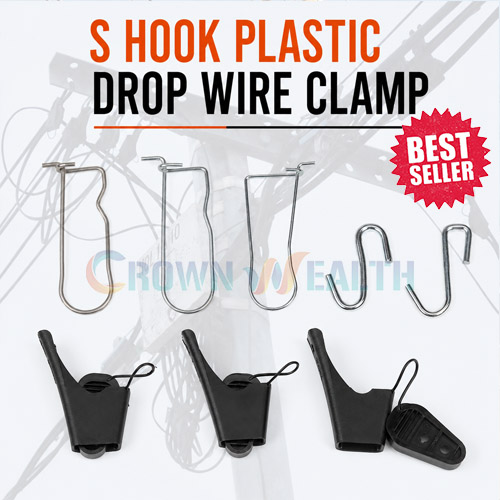
- Attach a drop wire clamp
- Support the support wire of a drop cable
- Redirect a drop cable around an obstacle
- Create an additional cable attachment point
- Improve flexibility in aerial distribution construction
Therefore, span clamps are especially useful in telecommunications, CATV, telephone, and FTTH networks.
How Does a Span Clamp Work?
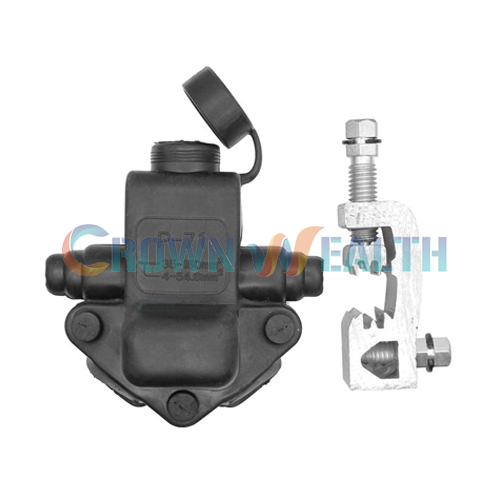
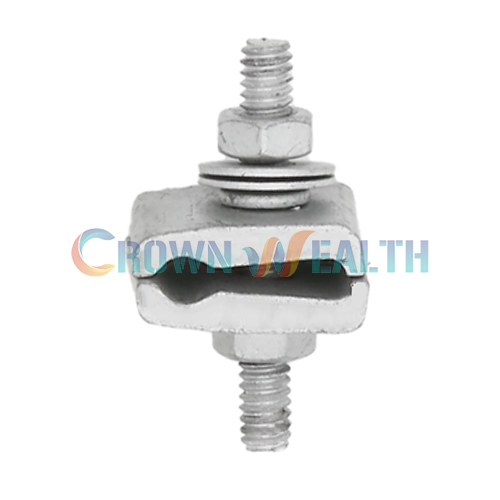
A span clamp normally uses two jaws, a bolt, and a nut to grip the messenger strand.
First, you position the jaws around the strand. Then you tighten the nut so the jaws grip the messenger securely.
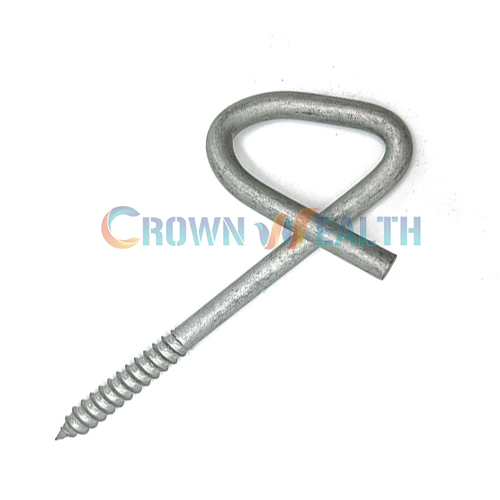
The hook, pigtail bolt, or other attachment section then provides a point where you can connect the drop wire clamp or supporting wire.
This allows you to create an attachment point in the middle of the span instead of relying only on the utility poles at each end.
For example, Hbcrownwealth’s Q Span Clamp is designed for messenger strand ranging from approximately 1/4″ to 7/16″ and is used for mid-span drop wire take-offs.
Main Parts of a Span Clamp
Although different models use different structures, most span clamps include several basic components.
Clamping Jaws
The jaws grip the messenger strand.
Depending on the model, manufacturers may use aluminum alloy, galvanized steel, or other suitable metals.
The jaw shape should match the intended strand range so that you can achieve secure contact without unnecessary movement.
Hook Bolt or Pigtail Bolt
The hook or shaped bolt provides the attachment point for the drop cable hardware.
Some span clamps use a pigtail-style design, while others use C-, E-, O-, or other hook structures.
Nut
The nut applies pressure to the jaws and secures the clamp to the messenger strand.
You should tighten it correctly during installation so the clamp cannot rotate or slide.
Surface Protection
Because you install span clamps outdoors, corrosion resistance is important.
Depending on the design, manufacturers may use hot-dip galvanizing, mechanical galvanizing, aluminum alloy, or other corrosion-resistant treatments.
Key Advantages of Span Clamps for Aerial Cable Installation
When you install aerial drop cables, a span clamp gives you a secure and convenient attachment point along the messenger strand. It also helps you improve cable routing and installation efficiency.
- Provides a Secure Mid-Span Attachment Point
You can create a reliable drop cable take-off point between utility poles without adding another pole attachment. - Helps Maintain Stable Cable Routing
A properly installed span clamp keeps the drop cable aligned and reduces unwanted movement along the aerial route. - Suitable for Outdoor Environments
With galvanized steel or corrosion-resistant metal components, span clamps can perform reliably in rain, wind, and changing weather conditions. - Long Service Life and Low Maintenance
Durable materials and protective surface treatments help reduce corrosion and maintenance requirements over time. - Quick and Easy to Install
You can install the clamp directly on the messenger strand with basic tools, which helps reduce installation time and labor costs. - Compatible With Different Aerial Drop Hardware
Depending on the model, you can connect drop wire clamps, cable support wires, and other compatible aerial fittings.
Mainstream Types and Applicable Scenarios
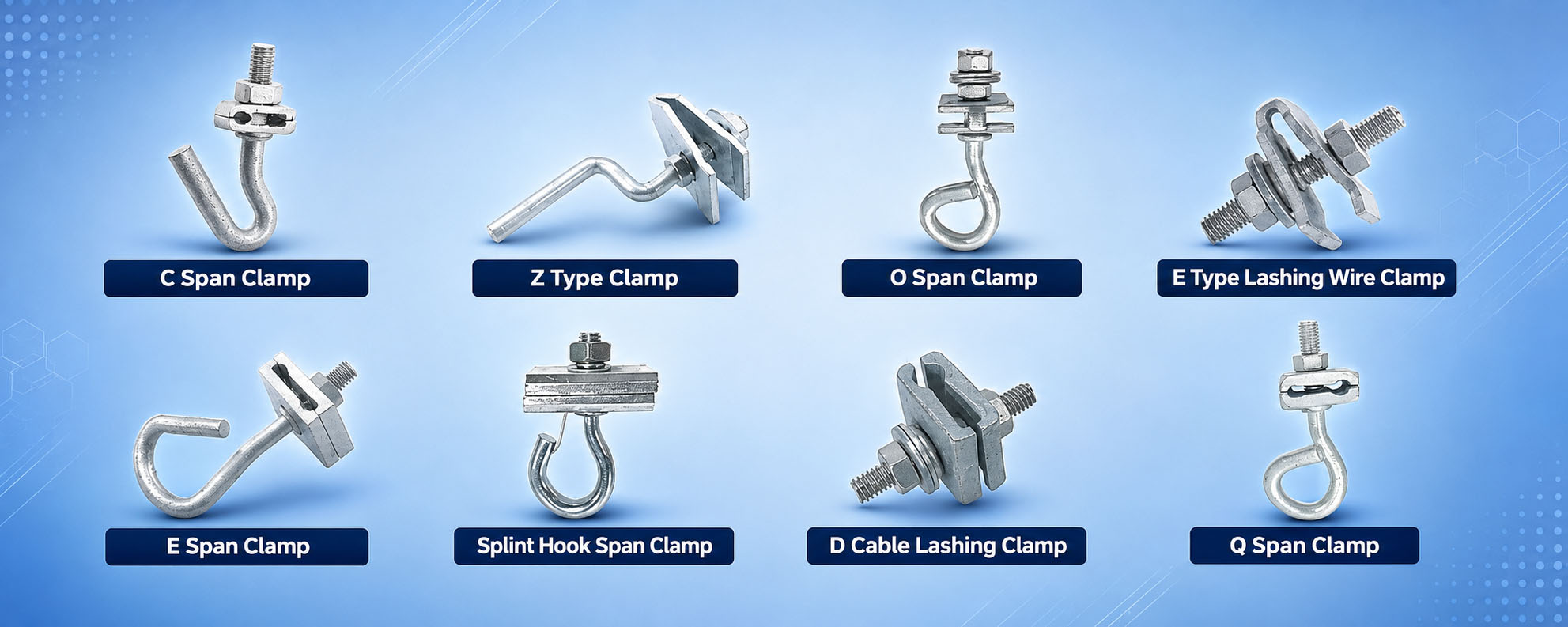
Medium tension wire clamp(suspension clamp or dead end clamp): Mainly used for cable systems with long spans.
Q type span clamp: Mainly used for FTTH optical cable lines.
E type span clamp: Mainly used in coastal areas or plain areas with strong winds.
C type span clamp: Designed for aerial optical cables, drop cables or phase cables with a diameter of 6-35 mm.
Z type span clamp: Used for lines with relatively undulating spans.
O type span clamp: Used for paralleling of lines above 15kV.
How to Choose the Correct Span Clamp
Before you install or order a span clamp, check several important specifications.
1. Check the Messenger Strand Size
First, confirm the diameter of your messenger strand.
Different span clamp jaws cover different strand ranges.
For example, some Q and E models cover approximately 1/4″ to 7/16″, while specific C models may use a different range.
Therefore, you should not assume that every span clamp fits the same strand.
2. Check the Drop Attachment Method
Next, decide what you need to connect to the clamp.
For example, you may need to connect:
- A drop wire clamp bail
- A support wire
- A drop cable
- A wire grip
- Other compatible aerial hardware
The attachment method will help you determine whether you need a Q, E, C, O, or another type.
3. Check the Clamp Material
Consider the jaw, bolt, and nut materials.
For outdoor installations, you should choose materials and surface treatments that provide suitable mechanical strength and corrosion resistance.
Installation Points
Use a wrench to open the nut buckle, prevent the optical cable from being inserted into the groove of the splint or one end of the deadend, and use a wrench to tighten the bolts and nuts to prevent the span clamp from loosening.(What you need to pay attention to is: do not press the insulation layer of the optical cable)
Why Choose Hbcrownwealth Span Clamps?
When you source aerial drop hardware, you need the individual components to work together.
Hbcrownwealth supplies multiple span clamp structures, including Q, E, C, O, S, Z, and multi-drop designs, together with related aerial drop hardware.
You can select products according to your messenger strand size, attachment method, cable system, and project requirements.
In addition, if you distribute telecom hardware or purchase for an infrastructure project, you can provide your drawings, required dimensions, material specifications, and order quantity for product matching and OEM production.
Frequently Asked Questions About Span Clamps
What is a span clamp?
A span clamp is aerial cable hardware that attaches to a messenger strand and provides an attachment point for drop cable or compatible drop wire hardware.
What is another name for a span clamp?
Buyers may also use terms such as span wire clamp, mid-span clamp, or aerial span clamp, depending on the market and application.
What is a span clamp used for?
You use a span clamp to create a drop wire take-off or cable attachment point somewhere along a messenger strand between utility poles.
Is a span clamp the same as a suspension clamp?
No. A span clamp normally mounts to a messenger strand, while a suspension clamp normally supports a cable at a pole or another supporting structure.
Can you use a span clamp with a drop wire clamp?
Yes. Many span clamps are specifically designed to accept the bail of a compatible drop wire clamp.
How do you choose the right span clamp?
Start with the messenger strand diameter. Then check the attachment method, span clamp type, material, mechanical requirements, and installation environment.
What sizes are available?
The available size depends on the model. For example, some Hbcrownwealth Q and E Span Clamps cover messenger strands from approximately 1/4″ to 7/16″.
What materials are used for span clamps?
Depending on the design, span clamps may use aluminum alloy jaws, steel jaws, galvanized steel bolts, nuts, and other corrosion-resistant components.