English
 Spanish
 French
 Arabic
Cable slack storage keeps reserved fiber cable organized, protected, and accessible on aerial networks. It is commonly installed on utility poles, transmission structures, and other support points in FTTH, ADSS, and OPGW projects. A properly selected storage bracket helps maintain the cable manufacturer’s minimum bend radius, reduces mechanical stress, and gives technicians usable spare cable for splicing, repair, relocation, or future expansion.
This guide explains where cable slack storage is used, why it matters, and which technical details you should check before purchasing a pole-mounted bracket.
What Is Cable Slack Storage?
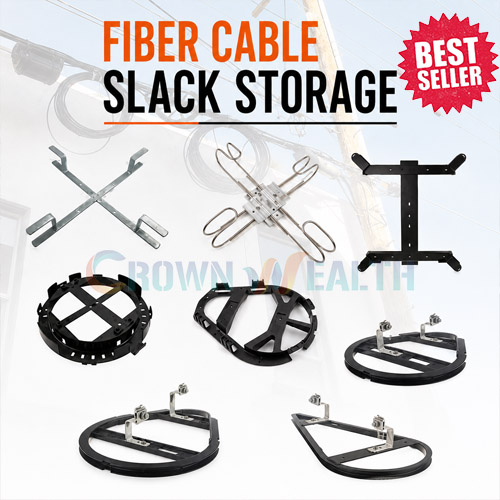
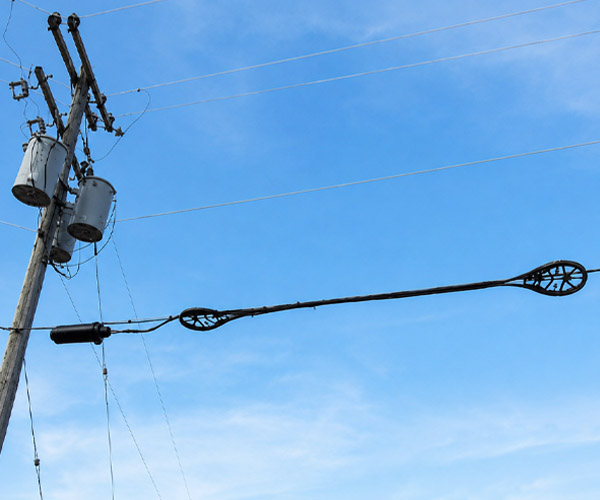
Cable slack storage is a cable-management bracket or frame that holds a controlled loop of excess fiber optic cable. Installers reserve this extra length so the cable can reach a splice point, be repaired after damage, or support a later network extension without replacing the full span.
A fiber optic cable slack storage bracket should support the cable without sharp bends, pinching, abrasion, or excessive tension. Depending on the network design, it may also be called a fiber slack storage unit, cable storage bracket, snowshoe, or pole-mounted fiber storage frame.
Why Is Cable Slack Storage Important?
Leaving excess cable loose on a pole can create uncontrolled loops that move in the wind, rub against hardware, or fall below the required clearance. Coiling the cable too tightly can also exceed its bend limit and increase attenuation or cause long-term fiber damage.
Correctly installed cable slack storage helps you:
- Maintain the specified minimum cable bend radius
- Reduce bending, twisting, abrasion, and localized pressure
- Keep reserved cable clear of climbing space and other utilities
- Give technicians faster access during splicing and repairs
- Improve the appearance and consistency of aerial installations
- Support future drops, route changes, and network expansion
- Reduce avoidable maintenance time and cable replacement
The bracket does not replace correct engineering practice. The final loop diameter, mounting height, clearances, and attachment method must follow the cable manufacturer’s instructions and the applicable utility or telecom standard.
Where Is Cable Slack Storage Used?
Utility Poles
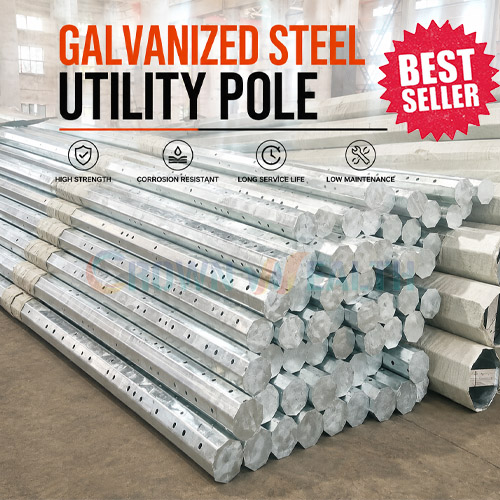
Wooden, concrete, and steel utility poles are the most common mounting locations. The bracket stores a service loop near a splice closure, branch point, or planned maintenance location. Stainless steel banding, bolts, or pole-specific fittings can be used according to the pole material and project rules.
FTTH and Last-Mile Fiber Networks
FTTH projects often reserve cable at distribution points and selected poles. This spare length helps technicians reach a closure, add a customer connection, or rework a damaged section. Organized storage is especially valuable in dense aerial corridors where multiple cables share the same pole.
ADSS Communication Lines
All-dielectric self-supporting cable is widely installed along distribution and transmission routes. Cable slack storage may be positioned near suspension points, dead ends, joints, or down-lead locations. It is normally coordinated with compatible ADSS cable guy grips, suspension hardware, pole bands, and down-lead clamps.
OPGW and Power-Utility Networks
Optical ground wire projects require carefully planned reserve cable near towers, substations, and joint boxes. The storage frame and fixing hardware must suit the structure, environmental load, cable construction, and utility specifications. For OPGW work, always confirm the approved bend radius and installation method with the cable and line-design documentation.
Industrial, Railway, Mining, and Smart-City Systems
Private fiber networks also use slack storage along plant roads, railway communication routes, mines, ports, surveillance systems, and intelligent transport networks. In these environments, technicians often need protected spare cable for rapid restoration while keeping the route accessible for inspection.
Typical Regional Installation Conditions
Cable slack storage is not limited to one country. It is used wherever operators deploy aerial fiber on poles or towers. The correct design depends more on local environmental and network conditions than on the market name.
- North America and Europe: rural broadband, FTTH overbuilds, utility communications, and shared-pole routes may require brackets that tolerate wind, ice, and repeated seasonal temperature changes.
- Australia, Latin America, Southeast Asia, and Africa: high UV exposure, heat, heavy rain, dust, salt air, and concrete-pole installation can influence material and fixing choices.
- Coastal and industrial areas: stainless steel or a suitable corrosion-resistant finish may be preferred after reviewing the environmental exposure.
- Cold regions: the installation must account for snow, ice, cable movement, and the clearance rules of the network owner.
These are general engineering considerations, not a substitute for local codes or the project specification.
How to Choose the Right Cable Slack Storage Bracket
1. Confirm the Cable Type and Diameter
Start with the cable construction—ADSS, OPGW, FTTH, figure-8, or another fiber cable—and its outside diameter. The frame dimensions and contact surfaces must fit the cable without crushing or creating sharp pressure points.
2. Follow the Minimum Bend Radius
Check the cable manufacturer’s minimum bend radius for both installation and long-term service. Select a storage loop that stays above the required value throughout the cable path. Do not rely on a generic radius because cable designs and operating conditions vary.
3. Match the Pole or Structure
Identify whether the bracket will be fixed to a wooden pole, concrete pole, steel pole, lattice tower, wall, or other structure. Confirm the required mounting holes, bolts, stainless banding, pole bands, or custom fittings. The attachment must resist movement without damaging the support structure.
4. Select a Suitable Material and Finish
| Material or finish | Typical advantage | Points to verify |
|---|---|---|
| Hot-dip galvanized steel | High strength and economical outdoor protection | Coating requirement, cut-edge protection, and project corrosion class |
| Stainless steel | Strong corrosion resistance for demanding environments | Required stainless grade, surface finish, and compatibility with other metals |
| UV-stabilized composite or polymer | Light weight, electrical insulation, and easy handling | UV resistance, temperature range, impact strength, and load capacity |
5. Review Environmental Loads
Consider wind, ice, temperature, UV exposure, vibration, salt spray, pollution, and expected service life. Material selection should be based on the project environment rather than appearance alone.
6. Plan Access and Clearance
The stored loop should be easy for trained technicians to reach without interfering with climbing zones, conductors, road clearance, signs, or other telecom equipment. Also check the distance from splice closures and the routing of the cable into and out of the frame.
Common Installation Mistakes to Avoid
- Making the storage loop smaller than the cable’s permitted bend radius
- Tightening straps or ties until they deform the cable jacket
- Allowing cable to rub against sharp metal edges
- Installing the bracket where vehicles, branches, tools, or climbing equipment can strike it
- Mixing metals without considering galvanic corrosion
- Using indoor-grade plastic, coating, or fasteners outdoors
- Ignoring the pole owner’s clearance and loading requirements
- Storing more cable than the bracket can hold securely
A pre-installation check of the cable datasheet, support structure, fixing method, and local standard prevents most of these problems.
Information to Send When Requesting a Quote
To receive an accurate recommendation, provide:
- Cable type, outside diameter, and datasheet
- Required minimum bend radius
- Amount of cable to be stored at each location
- Pole or tower type and available mounting space
- Preferred material or corrosion-protection requirement
- Wind, ice, UV, temperature, or coastal exposure
- Mounting hardware requirement
- Order quantity, packaging, and destination market
Clear project data helps the supplier confirm dimensions, materials, mounting accessories, and packaging before production.
Why Source Cable Slack Storage from Hbcrownwealth?
Hbcrownwealth manufactures pole-line and aerial fiber hardware for distributors, utilities, telecom contractors, and network projects. You can source cable slack storage together with compatible aerial fiber hardware to simplify purchasing and specification coordination.
- Steel, stainless steel, and engineered polymer options
- Hot-dip galvanized and corrosion-resistant finishes
- OEM and ODM support for dimensions, mounting, marking, and packaging
- Quality control from material inspection through final packing
- Low-MOQ and bulk-order support
- Mixed-product container loading
- Export experience serving utility and telecom buyers worldwide
For a project-specific recommendation, send your cable datasheet, pole type, installation environment, and required quantity through our contact page.
Frequently Asked Questions
How much fiber slack should be stored?
The required reserve length depends on the network design, splice plan, restoration method, and operator standard. Confirm the amount with the project engineer before selecting the bracket capacity.
Can one slack storage bracket be used for ADSS and OPGW cable?
Only if its dimensions, material, load capacity, mounting method, and bend radius meet the requirements of the specific cable and structure. Do not assume that one model fits every cable type.
Can cable slack storage be mounted on wooden, concrete, and steel poles?
Yes, but the fixing method may differ. Wooden poles may use approved bolts or screws, while concrete and steel poles often use stainless banding, pole bands, or structure-specific hardware.
Which material is best for outdoor cable slack storage?
The best choice depends on strength, UV exposure, corrosion risk, temperature, electrical requirements, and project specifications. Hot-dip galvanized steel, stainless steel, and UV-stabilized composite designs each suit different conditions.
Is cable slack storage the same as a splice closure?
No. The storage bracket manages the reserved cable loop. A splice closure protects fiber joints and splices. They are often installed near each other but perform different functions.