English
 Spanish
 French
 Arabic
A PA anchor clamp is a tension fitting designed to secure an aerial cable at a dead-end, terminal, angle, or building connection point. It grips the cable and transfers longitudinal tensile force to a pole bracket, hook, or other supporting hardware.
If you install FTTH, ADSS, ABC, or other overhead cable systems, choosing the right PA anchor clamp helps you maintain stable cable tension, protect the cable jacket, and simplify installation.
However, PA anchor clamps come in different cable ranges, materials, gripping structures, and mechanical load ratings. Therefore, you should select the clamp according to your cable diameter, cable type, tensile requirement, span length, and installation environment.
In this guide, you will learn how a PA anchor clamp works, where you can use it, how different types compare, and what you should check before buying from an anchoring clamp manufacturer.
What Is a PA Anchor Clamp?

Anchoring clamps are also called tension clamps or deadend clamps. They are mechanical fitting that anchors and tensions overhead cables.
You normally install it where the cable must transfer longitudinal load to a pole, wall, bracket, hook, or other supporting structure.
These locations usually include:
- Dead-end poles
- Terminal poles
- Angle poles
- Cable route changes
- Pole-to-building connections
- Distribution termination points
- FTTH aerial lines
- ADSS fiber optic networks
- ABC overhead cable systems
Most PA anchor clamps use a wedge-type gripping mechanism. When cable tension increases, the wedges grip the cable more firmly.
As a result, the clamp can maintain cable tension without requiring complicated adjustment.
Quick Answer
A PA anchor clamp secures an aerial cable under tension and transfers the pulling force from the cable to the supporting pole or structure.
This simple function makes it an important part of many overhead telecom and utility networks.
PA Anchor Clamp, Anchoring Clamp and Anchor Clamp: What Is the Difference?
You may see several names when sourcing overhead cable hardware.
Common search terms include:
- PA anchor clamp
- Anchoring clamp
- Anchor clamp
- Anchor tension clamp
- Tension clamp
- Dead-end clamp
- ABC anchor clamp
- ADSS anchor clamp
- Cable anchoring clamp
These terms often describe products with a similar purpose: holding an aerial cable at a point where the line carries longitudinal tension.
However, you should not assume that every anchor clamp fits the same cable.
Different models may vary in:
- Cable diameter range
- Cable shape
- Cable jacket material
- Grip design
- Working load
- Breaking load
- Body material
- Bail material
- Installation method
Therefore, you should always compare the technical specifications instead of selecting a clamp only by its product name.
How Does a PA Anchor Clamp Work?
Most PA anchor clamps use a self-adjusting wedge mechanism.
First, you place the aerial cable inside the gripping section.
Next, you position the wedges around the cable.
Then, when you apply cable tension, the wedges move deeper into the clamp body.
As the load increases, the gripping force also increases.
Consequently, the clamp transfers the cable tension through its body and bail to the pole bracket or other support.
This design offers several practical advantages.
First, you can install many models quickly.
Second, the wedge system distributes the gripping force over the cable surface.
Third, you normally do not need to strip the cable insulation.
Finally, the self-gripping structure helps reduce cable slippage during normal service.
What Are the Main Parts of a PA Anchor Clamp?
The exact structure depends on the model. However, a typical PA anchor clamp may include:
Clamp Body
The body supports the gripping mechanism and transfers the mechanical load.
Manufacturers may use UV-resistant engineering plastic or aluminum alloy.
Wedges
The wedges grip the cable when tension increases.
A well-designed gripping surface can help hold the cable while reducing unnecessary jacket damage.
Bail or Loop
The bail connects the clamp to a hook, bracket, eye bolt, or other pole fitting.
Manufacturers often use stainless steel or galvanized steel for this component.
Cable Groove
The cable groove guides the cable into the correct position and helps distribute gripping pressure.
Because these components work together, you should evaluate the complete clamp rather than focusing on one material alone.
Main Types of PA Anchor Clamps
You can find several types of PA and anchoring clamps in overhead networks.
The right type depends on your cable and mechanical requirements.
Plastic PA Anchor Clamp
A plastic PA anchor clamp normally uses a body made from UV-resistant engineering polymer.
You can commonly use this type for:
- FTTH networks
- Lightweight aerial cables
- Telecom cables
- Short or medium-span applications
- Some ADSS cable systems
The polymer body provides several advantages.
It offers electrical insulation, low weight, corrosion resistance, and easy handling.
In addition, UV-resistant materials can perform well during long-term outdoor exposure when you select the correct material grade.
However, you should still confirm the rated mechanical load before installation.
Aluminum PA Anchor Clamp
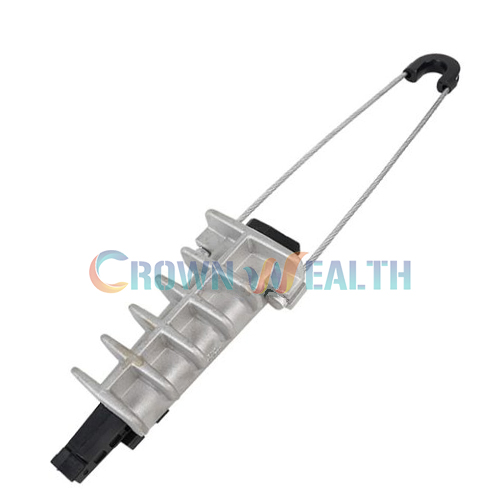
An aluminum anchor clamp uses aluminum alloy for the main body or load-bearing components.
You may choose this design when your project requires greater mechanical strength or a more rigid structure.
Common applications include:
- ADSS fiber optic cables
- ABC cables
- Utility distribution lines
- Higher-tension overhead applications
- Larger cable diameters
Aluminum alloy combines relatively low weight with good mechanical performance and corrosion resistance.
Nevertheless, you should match the clamp to the cable rather than choosing aluminum only because it appears stronger.
ADSS Anchor Clamp
An ADSS anchor clamp secures All-Dielectric Self-Supporting fiber optic cable at dead-end or tension points.
Because ADSS cable carries its own load between poles, the clamp must work with the cable jacket without crushing or slipping.
When you select an ADSS anchor clamp, check:
- Cable outside diameter
- Span length
- Maximum tensile load
- Cable jacket structure
- Environmental conditions
- Required safety factor
For longer spans or higher loads, you may need a stronger anchoring solution.
ABC Anchor Clamp
An ABC anchor clamp secures Aerial Bundled Cable at dead-end, terminal, or angle points.
ABC systems often carry higher mechanical loads than lightweight telecom cables. Therefore, the clamp structure, cable range, and mechanical performance become particularly important.
Before selecting an ABC anchor clamp, you should confirm:
- Cable configuration
- Cable diameter
- Conductor size
- Messenger design
- Required tensile load
- Applicable project standard
You should never select an ABC clamp based only on a photo or general size.
Where Do You Use a PA Anchor Clamp?
PA anchor clamps serve several overhead cable applications.
FTTH Networks
FTTH networks often use small aerial cables between poles and buildings.
A suitable PA anchor clamp can secure the cable at termination points while helping installers maintain the correct tension.
Because FTTH cables may be relatively small, you should pay particular attention to the cable diameter and gripping surface.
ADSS Fiber Optic Networks
ADSS cables often span longer distances between utility poles.
Therefore, cable weight, span length, wind, temperature changes, and terrain can create significant mechanical forces.
A properly selected anchor tension clamp transfers these loads to the pole hardware while helping protect the cable.
ABC Overhead Distribution Lines
You can use an ABC anchor clamp at dead-end poles, terminal points, and direction changes in aerial bundled cable networks.
These applications may require reinforced plastic or aluminum alloy designs depending on the cable and project requirements.
Pole-to-Building Connections
In telecom and distribution networks, an aerial cable may run from a pole to a building.
In this case, you can connect the anchoring clamp to:
- Wall hooks
- House hooks
- Eye bolts
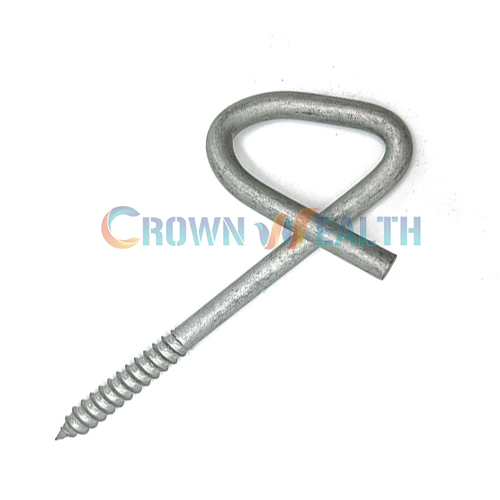
- Pigtail bolts
- Brackets
A compatible connection helps simplify installation and keeps the cable properly positioned.
Dead-End and Angle Poles
You normally need an anchor clamp wherever the line transfers longitudinal force to the pole.
Dead-end poles and angle poles are two common examples.
If the cable route changes direction, mechanical forces increase. Therefore, a standard suspension clamp may not provide the required function.
PA Anchor Clamp vs. Suspension Clamp
Buyers sometimes confuse an anchor clamp with a suspension clamp.
However, the two products perform different jobs.
| Feature | PA Anchor Clamp | Suspension Clamp |
|---|---|---|
| Main function | Anchors and tensions cable | Supports cable |
| Main load | Longitudinal tensile load | Mainly support load |
| Installation point | Dead-end, terminal, angle | Intermediate pole |
| Cable movement | Holds cable firmly | Supports cable position |
| Typical use | Cable termination | Straight-line support |
In simple terms:
You use a PA anchor clamp when you need to transfer cable tension. You use a suspension clamp when you mainly need to support the cable along its route.
Understanding this difference helps you avoid selecting the wrong overhead hardware.
Plastic PA Anchor Clamp vs. Aluminum Anchor Clamp
Material choice affects weight, mechanical performance, corrosion resistance, installation, and cost.
| Feature | Plastic PA Anchor Clamp | Aluminum Anchor Clamp |
| Body material | Engineering polymer | Aluminum alloy |
| Weight | Very low | Low |
| Corrosion resistance | Excellent | Very good |
| Electrical insulation | Good | Conductive |
| Typical application | FTTH, telecom, some ADSS | ADSS, ABC, utility |
| Mechanical capacity | Depends on model | Often suited to higher loads |
| Installation | Simple | Simple |
| Cost | Usually economical | Usually higher |
You should not automatically choose one material over the other.
Instead, select the clamp according to the actual cable and project requirements.
How Do You Choose the Right PA Anchor Clamp?
Choosing the correct PA anchor clamp requires more than matching a product photo.
You should check the following factors.
1. Confirm the Cable Diameter
Start with the cable outside diameter.
Every clamp has a recommended cable range.
If the cable is too small, the clamp may not grip it properly.
Conversely, if the cable is too large, installation may become difficult or damage the cable jacket.
Therefore, always provide your supplier with the actual cable diameter.
2. Identify the Cable Type
Next, tell the manufacturer exactly what cable you use.
Examples include:
- FTTH drop cable
- ADSS fiber optic cable
- Figure-8 cable
- ABC cable
- Insulated conductor
- Telecom aerial cable
- Messenger-supported cable
Two cables may have the same outside diameter but completely different mechanical structures.
For this reason, diameter alone does not guarantee compatibility.
3. Check the Required Tensile Load
Your PA anchor clamp must withstand the mechanical load generated by the line.
This load can depend on:
- Cable weight
- Span length
- Wind
- Ice
- Temperature
- Installation angle
- Terrain
- Cable tension
If your project specification provides a working load or breaking load, send this information to your supplier.
You should never choose an anchor tension clamp only by appearance.
4. Consider the Span Length
Longer spans usually create greater mechanical demand.
Therefore, a clamp suitable for a short FTTH building connection may not be appropriate for a long-span ADSS installation.
Tell your supplier the approximate span length so they can recommend a more suitable model.
5. Evaluate the Installation Environment
Outdoor cable hardware faces continuous environmental exposure.
Your clamp may need to withstand:
- UV radiation
- Rain
- Humidity
- Heat
- Cold
- Wind
- Dust
- Salt spray
- Industrial pollution
For polymer components, choose UV-resistant materials.
Meanwhile, stainless steel, galvanized steel, or corrosion-resistant aluminum components can improve performance in demanding environments.
6. Check the Mounting Hardware
Your PA anchor clamp must connect correctly to the pole or structure.
Depending on your project, you may need:
- Pole brackets
- House hooks
- Drive hooks
- Eye bolts
- Pigtail bolts
- Pole bands
- Stainless steel fixing bands
- Crossarm fittings
Choosing compatible pole line hardware can simplify both installation and purchasing.
How Do You Install a PA Anchor Clamp?

Installation varies by model, but many wedge-type PA clamps follow a similar process.
First, connect the bail or loop to the specified pole bracket or hook.
Next, open or position the gripping wedges.
Then, place the cable correctly inside the clamp.
After that, apply the required cable tension.
As the cable pulls against the clamp, the wedges increase their gripping force.
Finally, inspect the complete assembly.
Make sure:
- The cable sits correctly in the groove
- The wedges engage evenly
- The bail connects securely
- The cable jacket shows no visible damage
- The clamp aligns correctly with the line
Always follow the specific installation instructions for the selected model.
In addition, never force a cable into a clamp outside its rated diameter range.
Why Does PA Anchor Clamp Quality Matter?
A PA anchor clamp may look like a small component, but it carries an important mechanical load.
Low-quality materials or unstable dimensions can cause:
- Cable slippage
- Jacket damage
- Excessive sag
- Broken components
- Premature UV aging
- Corrosion
- Installation failures
- Additional maintenance
Therefore, you should not compare PA anchor clamps only by unit price.
For large-volume projects, consistent manufacturing becomes especially important.
A small variation across thousands of clamps can create major installation problems.
What Should You Send Before Requesting a PA Anchor Clamp Quote?
If you want an accurate quotation, give your supplier enough technical information.
Ideally, send:
Cable type: FTTH, ADSS, ABC, Figure-8, or another cable
Cable diameter: Minimum and maximum outside diameter
Required tensile load: Working or breaking load if available
Span length: Approximate pole-to-pole distance
Application: Dead end, angle pole, terminal, or building connection
Environment: Normal, coastal, desert, tropical, cold, or industrial
Mounting hardware: Hook, bracket, bolt, pole band, or other fitting
Quantity: Trial quantity and expected annual demand
Standard: Project or national standard if required
Drawing/photo: Recommended when the application is unusual
When you provide these details, the manufacturer can recommend a suitable anchoring clamp instead of simply offering a general model.
Why Choose Hbcrownwealth as Your PA Anchor Clamp Manufacturer?

Hbcrownwealth manufactures and supplies overhead telecom hardware and pole line fittings for international distributors, wholesalers, telecom contractors, utility companies, and infrastructure buyers.
You can source PA anchor clamps together with other related overhead hardware, including:
- Suspension clamps
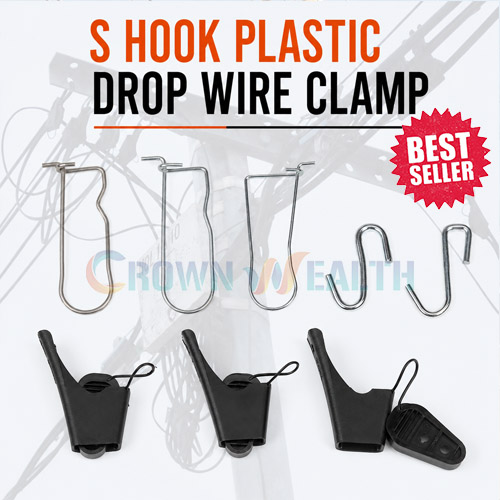
- Drop wire clamps
- Span clamps
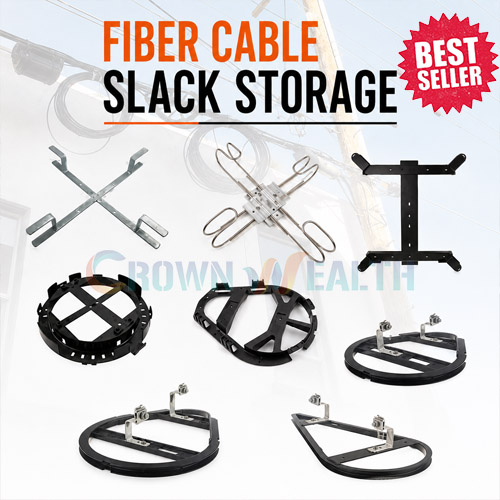
- Fiber Optic Cable Slack Storage
- House hooks
- Pole Line Bolts
- Pole bands
- Fixing bands
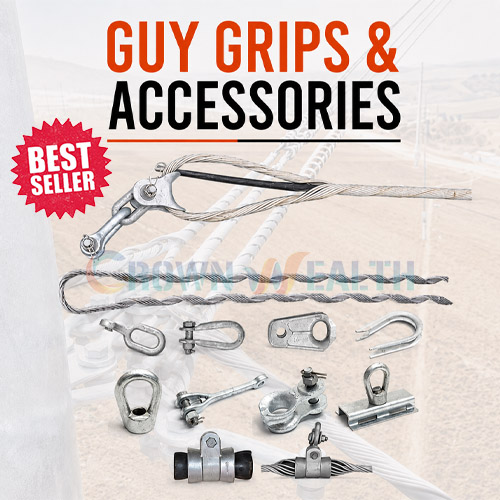
- Guy grips
- Guy clamps
By sourcing several product categories from one manufacturer, you can simplify purchasing, consolidate shipments, and reduce supplier management work.
Hbcrownwealth can also support OEM and ODM requirements for:
- Product specifications
- Cable ranges
- Packaging
- Labels
- Branding
- Bulk orders
- Mixed-container purchasing
If you are a distributor, wholesaler, importer, telecom contractor, or infrastructure buyer, you can send your cable specifications or drawings directly to our team.
We can help you select a suitable PA anchor clamp and related pole line hardware for your project.
What are the products related to anchoring clamps?

Stainless steel straps – Used to tie the bracket to the pole, fix the bracket and hanging clamp.
Stainless steel buckle – For fixing stainless steel straps.
Banding tools – For tightening stainless steel straps.
Armor Grip Suspension – Used to support and protect ADSS/OPGW cables from bending.
Down lead up clamp for pole/tower – Fix it to a utility pole or tower to prevent fiber optic cables from dangling.
Pole bands – Used to provide a platform for utility poles, fix and hang anchoring clamps.
Pole bracket – used with stainless steel straps to secure and suspend anchor clips.
Electrical cross arm – provides a platform for the tension clamp to hang from.
Frequently Asked Questions About PA Anchor Clamps
Q1. What is a PA anchor clamp?
A PA anchor clamp is a tension fitting that secures an aerial cable at a dead-end, terminal, angle, or other load-transfer point. It transfers longitudinal cable force to a pole bracket, hook, or supporting structure.
Q2. What is another name for a PA anchor clamp?
Depending on the market and application, buyers may call it an anchoring clamp, anchor clamp, anchor tension clamp, tension clamp, or dead-end clamp.
Q3. Is a PA anchor clamp suitable for ADSS cable?
Yes, some PA anchor clamps are designed for ADSS fiber optic cable. However, you should confirm the cable diameter, span length, tensile requirement, and jacket structure before choosing a model.
Q4. What is an ABC anchor clamp?
An ABC anchor clamp secures Aerial Bundled Cable at dead-end, terminal, or angle points in an overhead distribution network.
Q5. What is the difference between a PA anchor clamp and a suspension clamp?
A PA anchor clamp carries longitudinal cable tension at termination or tension points. A suspension clamp mainly supports the cable at intermediate poles.
Q6. How do I choose the correct PA anchor clamp size?
Start with the cable outside diameter. Then confirm the cable type, required tensile load, span length, installation environment, and mounting hardware.
Q7. Can one PA anchor clamp fit several cable diameters?
Some clamps cover a defined cable diameter range. However, you should always verify compatibility because cable shape, jacket material, and mechanical structure can also affect gripping performance.
Q8. Are plastic PA anchor clamps suitable for outdoor use?
Yes, when manufacturers use suitable UV-resistant engineering polymer. However, you should still check the material grade, temperature range, and project environment.
Q9. Can Hbcrownwealth customize PA anchor clamps?
Yes. You can provide your cable specifications, drawing, sample, packaging requirements, and order quantity to discuss OEM or ODM production.
Q10. Does Hbcrownwealth wholesale PA anchor clamps?
Yes. Hbcrownwealth supplies PA anchor clamps and related overhead telecom hardware to distributors, wholesalers, importers, contractors, and infrastructure buyers.
Choose the Right PA Anchor Clamp for Your Project
A reliable PA anchor clamp helps you maintain cable tension, protect the cable, simplify installation, and improve the stability of your overhead network.
However, the correct clamp depends on your cable and application.
Before ordering, confirm:
- Cable diameter
- Cable type
- Required tensile load
- Span length
- Installation environment
- Mounting method
In addition, work with a manufacturer that can provide stable production, technical specifications, and related overhead hardware.
If you need a PA anchor clamp, anchoring clamp, anchor tension clamp, ADSS anchor clamp, or ABC anchor clamp, send Hbcrownwealth your cable specifications, drawing, quantity, or project requirements.
Contact Hbcrownwealth for factory-direct PA anchor clamp quotations, wholesale supply, and OEM/ODM support.