English
 Spanish
 French
 Arabic
If you work with overhead power lines, FTTH networks, ADSS fiber optic cables, or ABC (Aerial Bundled Cable) systems, you have probably heard of an anchor clamp. However, many people still ask an important question: What is an anchor clamp, and why is it essential for overhead cable installations?
The answer is simple. An anchor clamp is one of the most important components in any aerial cable system because it securely anchors a cable at the end of a line or at a direction change while maintaining the required mechanical tension. Without a reliable anchor clamp, cables may sag, slip, or become damaged under wind, ice, or heavy mechanical loads.
Today, anchor clamps are widely used in telecommunications, electrical distribution, broadband deployment, rural electrification, and renewable energy projects. They provide a safe, durable, and maintenance-friendly solution for supporting insulated cables without damaging the cable jacket.
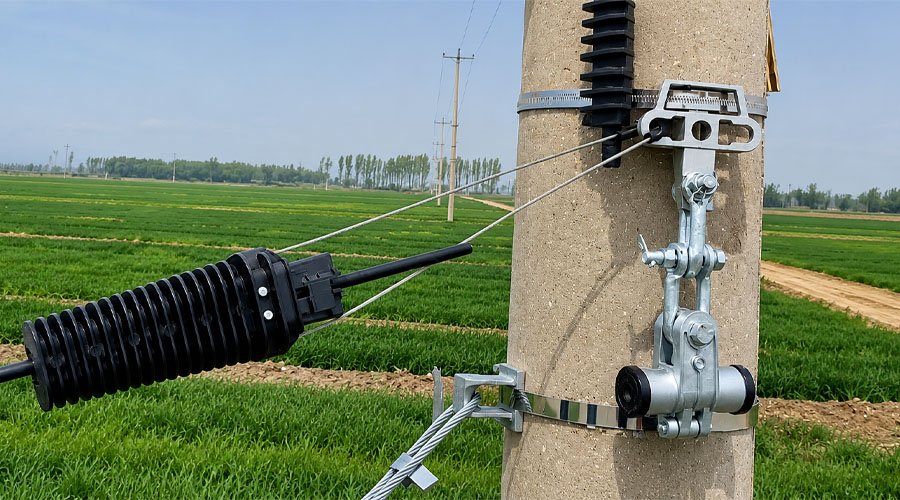
Whether you are a contractor, utility company, distributor, or project engineer, this guide will help you select the right anchor clamp for your overhead cable project.
What Is an Anchor Clamp?
An anchor clamp, also called an anchoring clamp, dead-end clamp, or tension clamp, is a mechanical fitting designed to securely grip and terminate overhead cables while transferring mechanical loads to a pole, wall bracket, or other supporting structure.
Unlike suspension clamps, which simply support a cable along its route, an anchor clamp is specifically designed to withstand longitudinal tension. It firmly holds the cable in place and prevents movement even under heavy mechanical loads.
By locking the cable securely, the clamp prevents excessive movement and helps maintain the designed cable tension throughout the entire network.
Because of their self-locking design, modern anchor clamps become tighter as the cable tension increases. This automatic gripping mechanism makes them extremely reliable for outdoor applications.
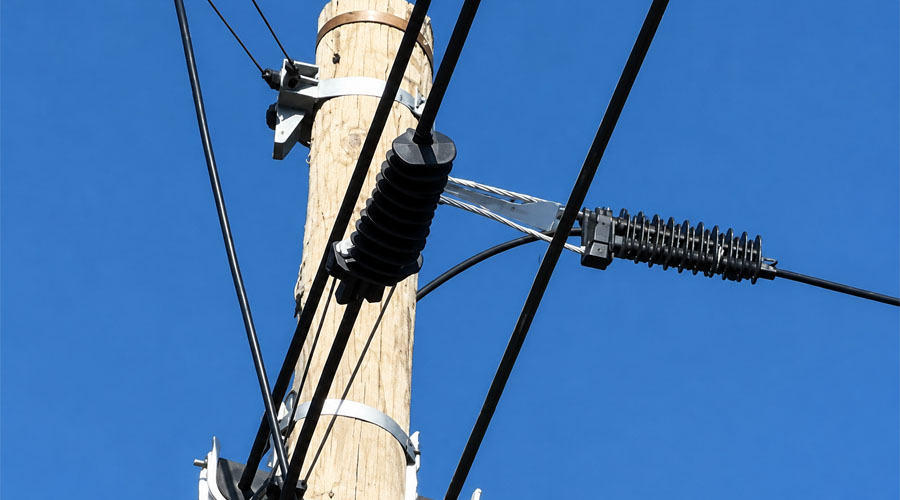
What Does an Anchor Clamp Do?
An anchor clamp performs several important functions simultaneously.
Its main function is:
- Secure overhead cables safely
- Maintain proper cable tension
- Prevent cable slippage
- Protect cable insulation
- Reduce vibration
- Extend cable service life
- Improve overall network reliability
Instead of using bolts or complicated adjustment systems, most modern anchor clamps use self-adjusting wedges that automatically grip the cable more tightly as the pulling force increases.
This simple yet highly effective design makes installation faster while significantly improving long-term performance.
How Does an Anchor Clamp Work?
Although different manufacturers may use slightly different designs, the working principle of most anchor clamps is remarkably similar.
A typical anchor clamp consists of several key components:
- UV-resistant plastic or aluminum body
- Self-adjusting wedges
- Stainless steel bail
- Cable gripping channel
- Suspension or anchoring eye
When you insert the cable into the clamp body, the internal wedges move freely. As tension is applied to the cable, the wedges slide deeper into the housing and automatically increase their gripping force.
In other words, the greater the pulling force, the stronger the cable is held.
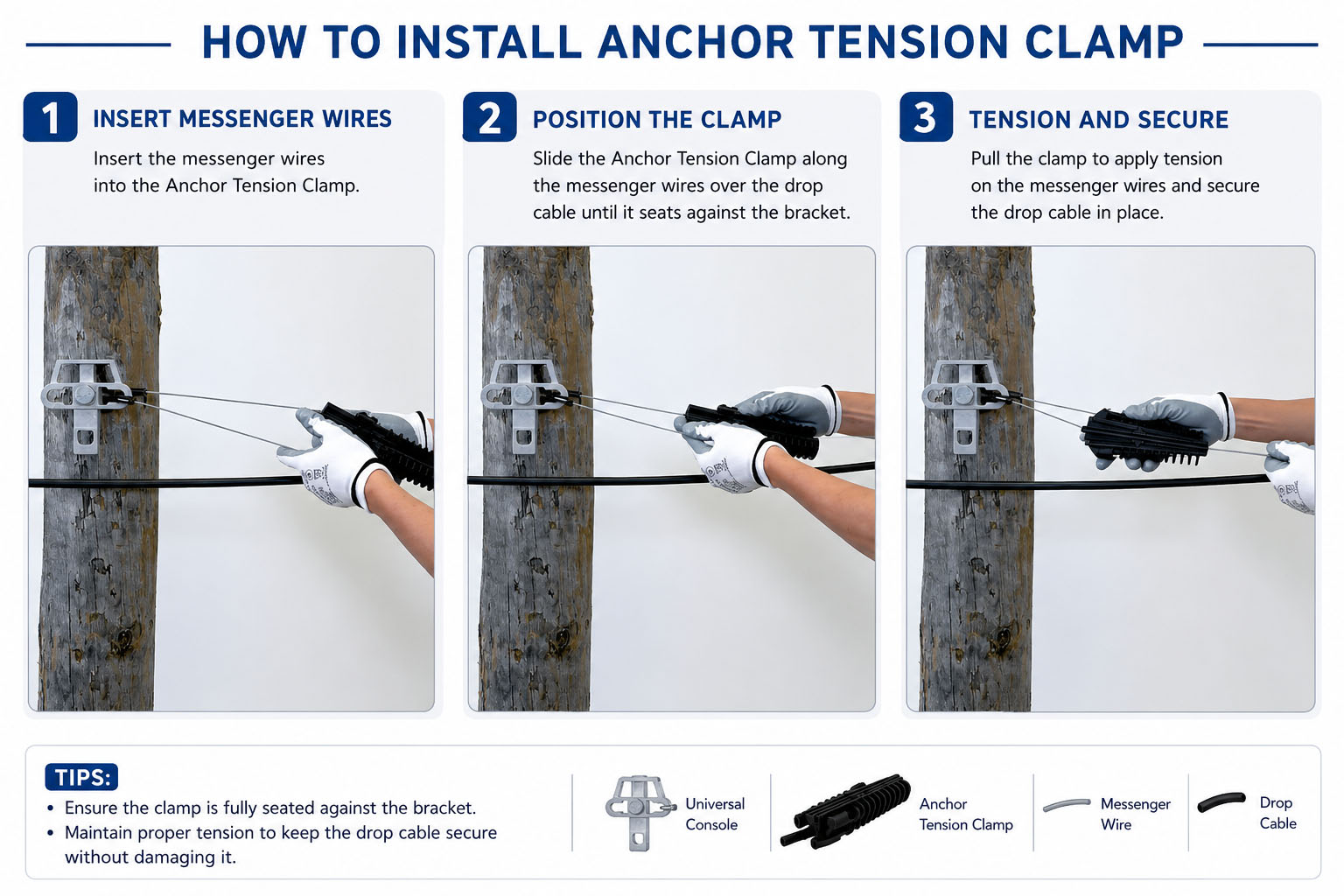
This self-tightening mechanism offers several important advantages:
1. Automatic Cable Locking
Once tension is applied, the wedges automatically lock onto the cable.
No additional tightening is required.
2. Even Pressure Distribution
Instead of concentrating force at one point, the clamp distributes pressure evenly along the cable surface.
This helps prevent insulation damage.
3. Slip Prevention
Because the gripping force increases with cable tension, the cable is far less likely to slip during operation.
This feature is particularly valuable in areas exposed to strong winds or heavy ice loads.
4. Load Transfer
The mechanical load is transferred from the cable to the stainless steel bail and then to the pole bracket or hook.
As a result, the cable itself experiences less stress.
5. Long-Term Stability
Since there are no complicated moving parts, modern anchor clamps require very little maintenance while providing years of reliable service in harsh outdoor environments.
Where Are Anchor Clamps Used?
One of the biggest advantages of anchor clamps is their versatility. You can use them in a wide variety of overhead cable installations across different industries.
Below are the most common applications.
1. FTTH Networks
Fiber-to-the-Home (FTTH) networks require lightweight yet secure cable anchoring solutions.
Plastic anchor clamps are commonly used to secure drop cables between utility poles and residential buildings.
Popular Hbcrownwealth models include:
These models are designed for fast installation while protecting delicate fiber optic cables.
2. ADSS Fiber Optic Cable Systems
All-Dielectric Self-Supporting (ADSS) cables are widely installed along power distribution lines.
Because these cables experience continuous mechanical tension, reliable anchor clamps are essential.
Depending on the cable diameter and span length, Hbcrownwealth offers models such as:
These clamps provide excellent gripping performance while preventing damage to the cable sheath.
3. ABC (Aerial Bundled Cable) Networks
Anchor clamps are widely used in low-voltage and medium-voltage ABC distribution systems.
They safely terminate insulated conductors and maintain the required line tension.
For ABC installations, high-strength aluminum anchor clamps are often preferred because they provide greater mechanical strength and longer service life under heavy loads.
4. Utility Pole Distribution Lines
Electric utility companies use anchor clamps on:
- Dead-end poles
- Angle poles
- Corner poles
- Terminal poles
They ensure stable cable positioning while minimizing maintenance requirements.
5. Telecommunication Networks
Modern telecommunications infrastructure relies heavily on anchor clamps.
They are commonly installed in:
- Fiber optic backbone networks
- Internet service provider networks
- CATV systems
- Broadband expansion projects
- Rural communication projects
Reliable anchoring ensures uninterrupted signal transmission and long-term network stability.
Types of Anchor Clamp
Although dozens of anchor clamp designs are available on the market, most products fall into two major categories based on their material and intended application:
- Plastic Anchor Clamp
- Aluminum Anchor Clamp
Understanding the differences between these two categories will help you choose the right solution for your project.
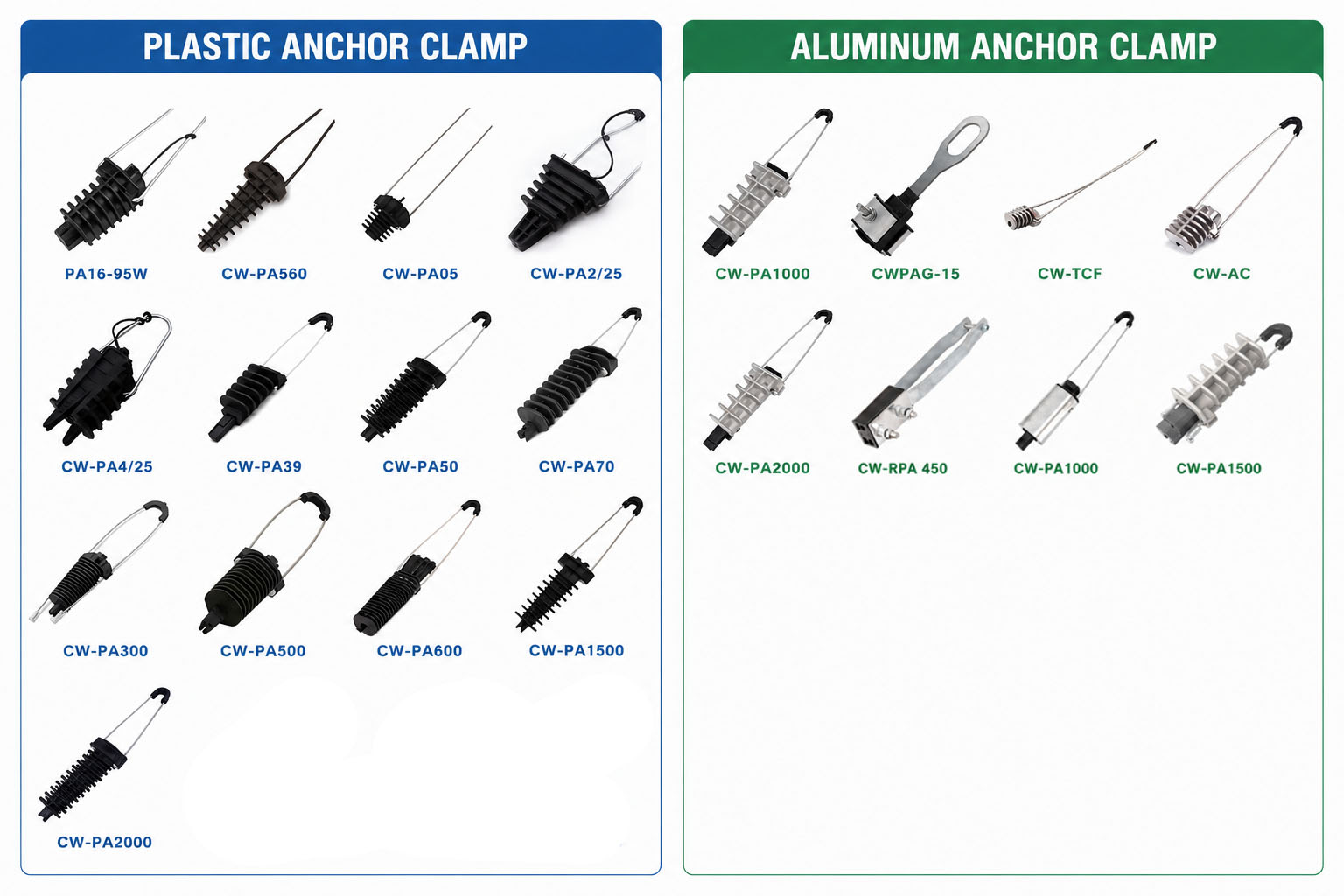
1. Plastic Anchor Clamp
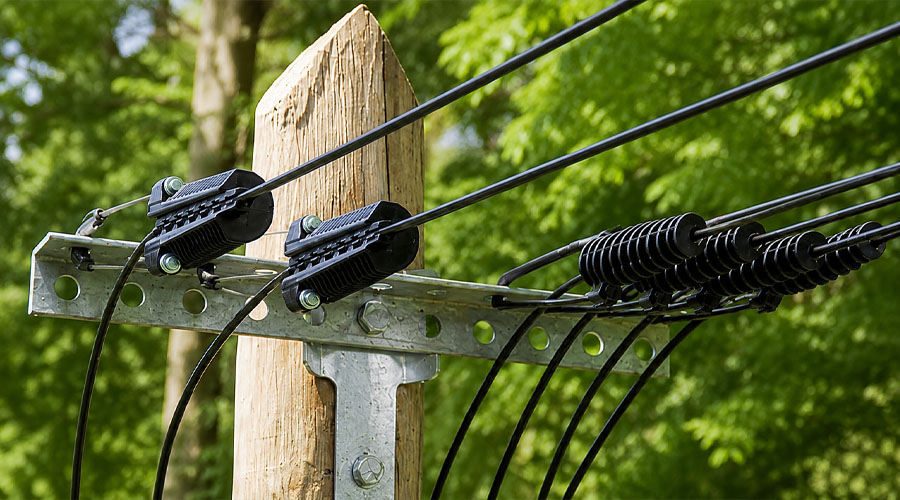
Plastic anchor clamps are the most widely used solution for FTTH drop cables, ADSS fiber optic cables, and lightweight aerial cables. They combine a high-strength engineering polymer body with self-adjusting wedges and a corrosion-resistant stainless steel bail.
Modern engineering plastics are far stronger than many people expect. High-quality UV-resistant polymers can withstand years of outdoor exposure while maintaining excellent mechanical strength and dimensional stability.
At Hbcrownwealth, plastic anchor clamps are manufactured using premium UV-resistant engineering plastics to ensure outstanding performance in demanding environments.
Typical Features
Plastic anchor clamps offer several advantages:
- Lightweight design
- UV-resistant housing
- Excellent corrosion resistance
- Self-locking wedge mechanism
- Fast installation without special tools
- Suitable for insulated cables
- Long outdoor service life
- Low maintenance requirements
Because the clamp grips the cable without damaging its insulation, it is particularly suitable for modern fiber optic and telecommunications networks.
Typical Applications
You can use plastic anchor clamps in a variety of applications, including:
- FTTH drop cable installations
- ADSS fiber optic networks
- Broadband infrastructure
- CATV systems
- Rural telecommunications
- Small-span overhead lines
- Building-to-building cable installations
Typical Hbcrownwealth Plastic Anchor Clamp Models
Hbcrownwealth supplies a comprehensive range of plastic anchor clamps, including:
| Model | Typical Cable Diameter | Typical Application |
|---|---|---|
| PA2/25 | Small FTTH Drop Cable | FTTH Network |
| PA4/25 | Fiber Drop Cable | Residential FTTH |
| PA25 | Light ADSS Cable | Telecom Network |
| PA50 | Small ADSS Cable | Fiber Distribution |
| PA70 | Medium Fiber Cable | Utility Pole |
| PA150 | Medium Span ADSS | Telecommunications |
| PA300 | Larger Fiber Cable | Distribution Network |
| PA500 | Medium Mechanical Load | Utility Projects |
| PA600 | Heavy Fiber Cable | Communication Network |
These models cover most light and medium-duty overhead cable applications and are trusted by installers worldwide.
2. Aluminum Anchor Clamp
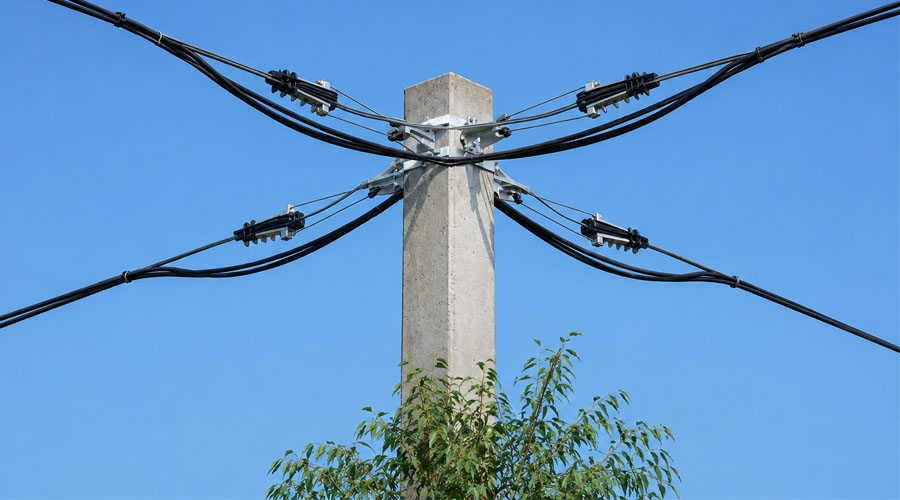
When your project requires higher mechanical strength, longer spans, or heavier cable loads, aluminum anchor clamps become the preferred choice.
Unlike plastic models, aluminum anchor clamps use a high-strength aluminum alloy body that provides exceptional durability while remaining lightweight.
Because aluminum naturally resists corrosion, these clamps perform exceptionally well in coastal regions, industrial environments, and areas with significant temperature variations.
Typical Features
Aluminum anchor clamps provide:
- Higher breaking load
- Excellent mechanical strength
- Outstanding corrosion resistance
- Superior long-span performance
- Stable performance under heavy wind loads
- Better heat dissipation
- Longer service life in harsh environments
These characteristics make aluminum anchor clamps ideal for demanding electrical distribution projects.
Typical Applications
Aluminum anchor clamps are widely used in:
- ABC cable systems
- Medium-voltage overhead lines
- Low-voltage distribution networks
- Heavy ADSS installations
- Long-span fiber optic routes
- Utility power distribution
- Industrial electrical projects
Typical Hbcrownwealth Aluminum Anchor Clamp Models
Hbcrownwealth manufactures a complete range of aluminum anchor clamps designed for demanding applications, including:
- PA1000
- PA1500
- PA2000
- PA3000
These models provide higher tensile strength and excellent long-term reliability for overhead power and communication networks.
Plastic vs. Aluminum Anchor Clamp
Choosing between plastic and aluminum anchor clamps depends on your project requirements rather than simply selecting the strongest option.
The table below summarizes the main differences.
| Feature | Plastic Anchor Clamp | Aluminum Anchor Clamp |
| Material | UV-Resistant Engineering Polymer | High-Strength Aluminum Alloy |
| Weight | Very Light | Light |
| Corrosion Resistance | Excellent | Excellent |
| UV Resistance | Excellent | Excellent |
| Breaking Load | Medium | High |
| Suitable Cable Size | Small to Medium | Medium to Large |
| Installation | Very Easy | Easy |
| Typical Applications | FTTH, ADSS, Telecom | ABC, Power Distribution |
| Cost | More Economical | Higher Investment |
In many FTTH and fiber optic projects, plastic anchor clamps provide the ideal balance between performance and cost. However, if your cables carry greater mechanical loads or span longer distances, aluminum anchor clamps are generally the better choice.
Advantages of Using an Anchor Clamp
An anchor clamp does much more than simply hold a cable in place. It improves the overall safety, reliability, and lifespan of your entire overhead network.
Below are some of the key advantages.
1. Prevents Cable Slippage
One of the primary functions of an anchor clamp is preventing cable movement.
As cable tension increases, the internal wedges automatically increase their gripping force, reducing the risk of cable slippage.
2. Maintains Proper Cable Tension
Maintaining consistent cable tension is essential for both electrical and communication systems.
Anchor clamps help keep cables properly tensioned, reducing excessive sag and ensuring long-term network stability.
3. Protects Cable Insulation
Unlike traditional metal clamps that may damage the cable jacket, modern anchor clamps distribute pressure evenly across the cable surface.
This significantly reduces the risk of insulation damage.
4. Speeds Up Installation
Most Hbcrownwealth anchor clamps feature a simple self-locking design.
You can install them quickly without complicated adjustments or specialized equipment, saving both labor and installation time.
5. Reduces Maintenance Costs
Because anchor clamps have very few moving parts, they require minimal maintenance after installation.
This helps lower long-term operating costs.
6. Performs Well in Harsh Outdoor Conditions
High-quality anchor clamps are designed to withstand:
- UV radiation
- Rain
- Snow
- Ice
- High humidity
- Salt spray
- Extreme temperatures
As a result, they continue to perform reliably even in demanding environments.
7. Improves Network Reliability
A properly selected anchor clamp reduces the likelihood of cable movement, mechanical failure, and unexpected outages.
This contributes to a more reliable overhead distribution network.
8. Extends Cable Service Life
By reducing stress, vibration, and abrasion, anchor clamps help protect the cable itself.
This can significantly extend the service life of your aerial cable system.
Benefits of Anchor Clamps in Overhead Cable Networks
Whether you are building a telecommunications network or an electrical distribution system, anchor clamps provide measurable benefits throughout the project lifecycle.
By choosing the right anchor clamp, you can:
- Improve installation efficiency
- Reduce labor costs
- Increase cable stability
- Enhance network safety
- Extend cable lifespan
- Minimize maintenance requirements
- Lower overall operating costs
- Improve resistance to wind and vibration
- Protect cable insulation
- Ensure long-term mechanical reliability
For contractors and utility companies, these advantages translate into faster project completion, fewer maintenance visits, and greater customer satisfaction.
How to Choose the Right Anchor Clamp
Selecting the right anchor clamp is one of the most important decisions you will make when designing or installing an overhead cable network. A clamp that is too small may damage the cable or fail under load, while an oversized clamp may not provide enough gripping force.
Fortunately, choosing the correct anchor clamp is straightforward if you evaluate a few key factors.
1. Choose According to Cable Diameter
The first and most important factor is cable diameter.
Every anchor clamp is designed to accommodate a specific cable diameter range. If the cable falls outside that range, the clamp may not grip the cable correctly.
Before placing an order, always measure the cable’s outside diameter (OD) and compare it with the clamp’s recommended cable range.
For example:
| Cable Diameter | Recommended Application | Typical Hbcrownwealth Models |
|---|---|---|
| 2–6 mm | FTTH Drop Cable | PA2/25 |
| 4–8 mm | Fiber Drop Cable | PA4/25 |
| 6–12 mm | Light ADSS Cable | PA25, PA50 |
| 8–15 mm | Medium ADSS Cable | PA70, PA150 |
| 10–16 mm | Distribution Fiber Cable | PA300, PA500 |
| 14–20 mm | Heavy ADSS / ABC Cable | PA1000, PA1500 |
| 16–25 mm | Heavy Distribution Cable | PA2000, PA3000 |
Choosing the correct diameter range ensures that the internal wedges apply uniform pressure without crushing or slipping on the cable.
2. Consider the Required Tensile Load
Next, evaluate the mechanical load that the clamp must withstand.
Every overhead cable installation experiences tension caused by:
- Cable weight
- Span length
- Wind pressure
- Ice loading
- Temperature changes
- Terrain conditions
For this reason, you should always select an anchor clamp with a rated breaking load that exceeds the maximum expected working load.
As a general recommendation:
- FTTH drop cable installations usually require lower tensile strength.
- Standard ADSS networks require medium breaking loads.
- ABC power distribution and long-span installations require high-strength aluminum anchor clamps.
Choosing a clamp with an adequate safety margin will improve long-term reliability and reduce the risk of mechanical failure.
3. Identify Your Cable Type
Not all overhead cables have the same structure or mechanical properties. Therefore, the type of cable you are installing also influences your clamp selection.
FTTH Drop Cable
FTTH cables are lightweight and have relatively small diameters. Compact plastic anchor clamps such as PA2/25 and PA4/25 are typically the best choice.
ADSS Fiber Optic Cable
ADSS cables are self-supporting and carry significant mechanical tension over long distances. Models such as PA70, PA300, PA500, and PA1000 are commonly used depending on the cable diameter and span length.
ABC (Aerial Bundled Cable)
ABC systems carry electrical conductors and are subjected to higher mechanical loads. For these applications, high-strength aluminum anchor clamps such as PA1500, PA2000 are generally recommended.
Selecting a clamp specifically designed for your cable type helps maximize both safety and service life.
4. Evaluate the Span Length
The distance between two support poles, commonly known as the span, directly affects the mechanical tension applied to the cable.
As the span increases, so does the tensile force.
As a general guideline:
- Short spans often require standard plastic anchor clamps.
- Medium spans may require reinforced plastic or aluminum models.
- Long spans typically demand heavy-duty aluminum anchor clamps with higher breaking loads.
If your project includes multiple span lengths, choose the clamp based on the longest or most demanding section.
5. Consider the Installation Environment
Environmental conditions have a significant impact on the long-term performance of an anchor clamp.
Before making your selection, consider whether the installation site is exposed to:
- Strong UV radiation
- Coastal salt spray
- High humidity
- Heavy rainfall
- Snow and ice
- Industrial pollution
- Large temperature fluctuations
Hbcrownwealth anchor clamps are manufactured using UV-resistant engineering polymers, high-strength aluminum alloys, and stainless steel components to ensure reliable performance in demanding outdoor
Hbcrownwealth Anchor Clamp Selection Guide
The table below provides a quick reference when selecting a suitable Hbcrownwealth anchor clamp.
| Project Type | Recommended Clamp Category | Typical Models |
| FTTH Drop Cable | Plastic Anchor Clamp | PA2/25, PA4/25 |
| Residential Fiber Network | Plastic Anchor Clamp | PA39, PA50 |
| Standard ADSS Cable | Plastic Anchor Clamp | PA70, PA300 |
| Medium ADSS Installation | Reinforced Plastic | PA500, PA560, PA600 |
| Heavy ADSS Installation | Aluminum Anchor Clamp | PA1000 |
| ABC Distribution Line | Aluminum Anchor Clamp | PA1500, PA2000 |
| Long-Span Utility Network | Aluminum Anchor Clamp | PA2000 |
Always confirm the cable diameter, mechanical load, and installation conditions before making your final selection.
Installation Tips
Proper installation is just as important as choosing the right clamp.
To achieve the best performance, follow these practical recommendations.
Measure the Cable First
Always verify the cable’s outside diameter before selecting or installing the clamp.
Inspect the Clamp
Before installation, check that the clamp body, wedges, and stainless steel bail are free from damage.
Position the Cable Correctly
Insert the cable fully into the gripping channel and ensure that the wedges sit evenly around the cable.
Avoid Excessive Force
Modern self-locking anchor clamps do not require excessive tightening. Allow the wedge mechanism to generate the necessary gripping force.
Check Alignment
Make sure the clamp, cable, and pole bracket are aligned correctly to avoid uneven loading.
Perform a Final Inspection
After installation, verify that the cable is firmly secured and that all hardware is properly engaged.
Following these simple steps will help maximize the performance and service life of both the anchor clamp and the cable system.
Why Choose Hbcrownwealth Anchor Clamps?
Choosing the right supplier is just as important as choosing the right product. When you work with Hbcrownwealth, you gain more than a reliable anchor clamp—you gain an experienced manufacturing partner committed to quality, consistency, and long-term cooperation.
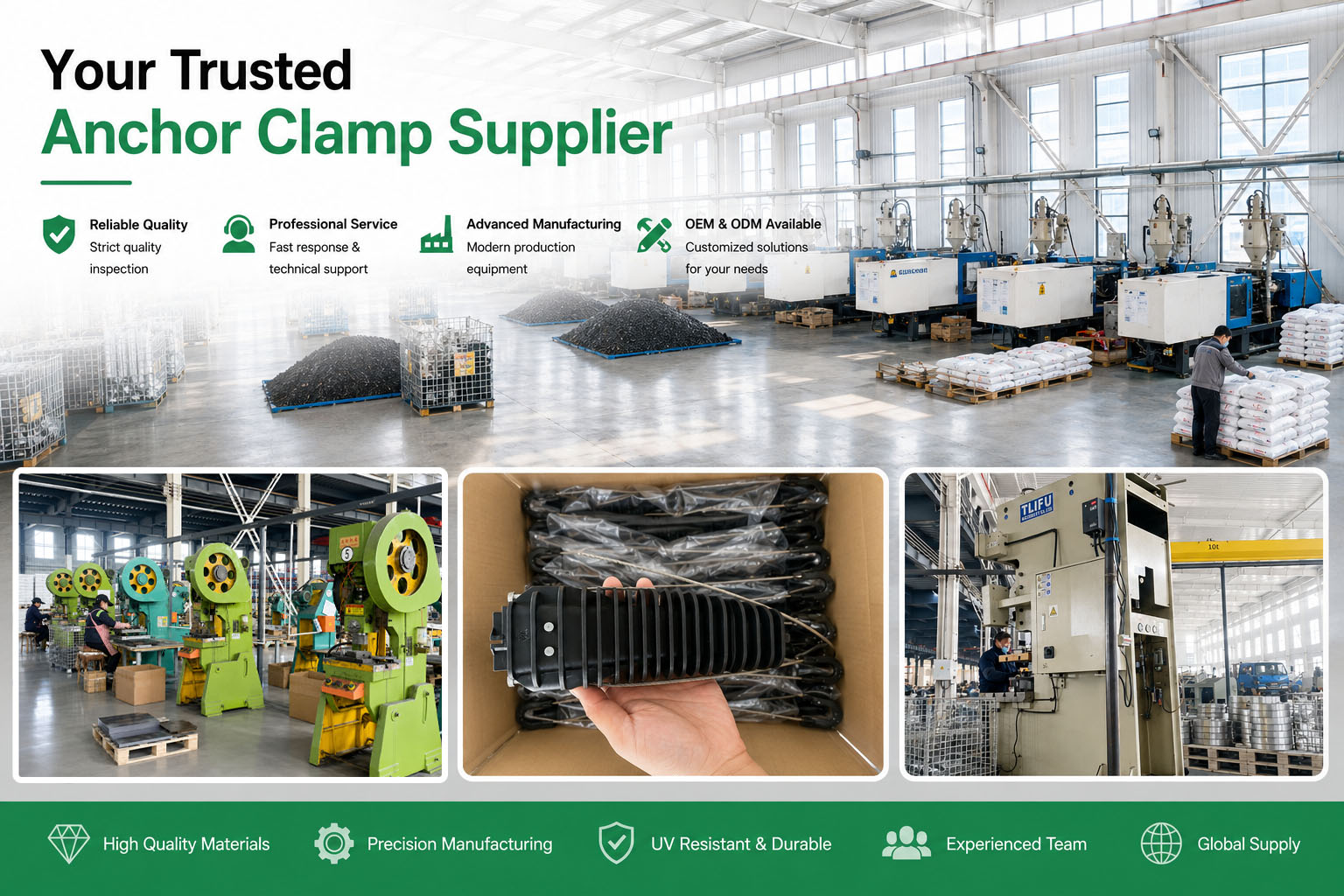
Over 14 Years of Manufacturing Experience
With more than 14 years of experience in the pole line hardware industry, Hbcrownwealth understands the technical requirements of utility companies, telecommunications contractors, distributors, and EPC projects worldwide.
Complete Product Range
Hbcrownwealth offers a comprehensive portfolio of anchor clamps for different applications, including:
- Anchor Clamps
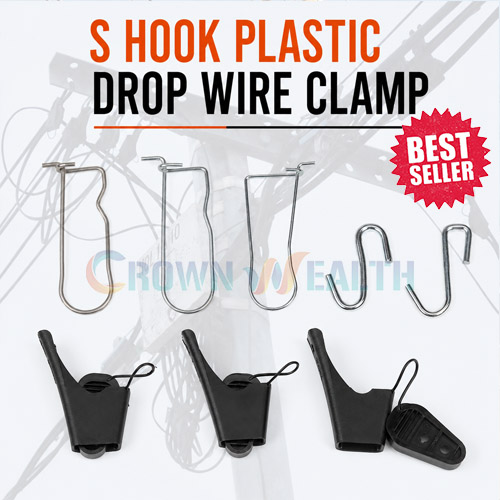
- FTTH Drop Wire Clamps
- Span Clamp
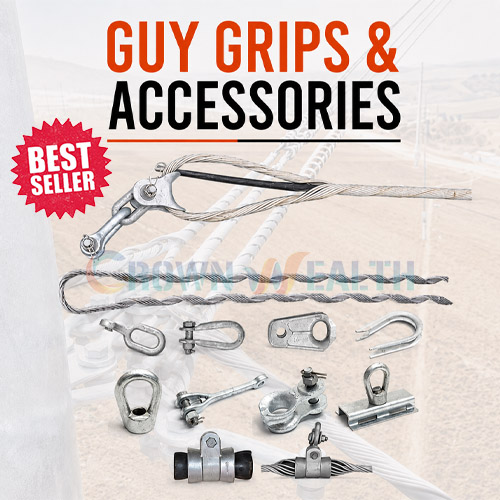
- Guy Grip
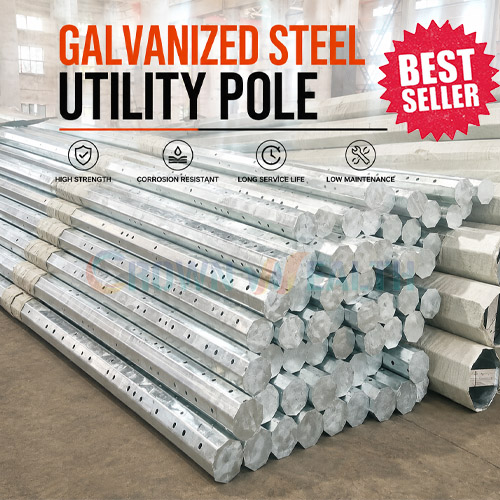
- Galvanized Steel Utility Pole
- Pole Line Hardware
This extensive product range allows you to source compatible hardware from a single manufacturer.
High-Quality Materials
Every anchor clamp is manufactured using carefully selected materials, including:
- UV-resistant engineering polymers
- High-strength aluminum alloy
- Stainless steel components
These materials are chosen to deliver excellent mechanical performance and long-term resistance to corrosion, UV exposure, and harsh outdoor environments.
Strict Quality Control
Quality is integrated into every stage of production.
From raw material inspection to finished product testing, Hbcrownwealth follows rigorous quality control procedures to ensure that every anchor clamp meets the required mechanical and dimensional specifications.
OEM & ODM Manufacturing
Whether you require customized dimensions, branding, packaging, or private-label production, Hbcrownwealth provides flexible OEM and ODM solutions tailored to your business needs.
Export Experience
Hbcrownwealth products are supplied to customers in more than 60 countries and regions, serving telecommunications operators, utility companies, distributors, and infrastructure contractors across global markets.
This international experience enables the company to understand different technical standards and project requirements.